Month: July, 2006
Hearst Tower
Much has been written about the new Hearst Tower, designed by Lord Norman Foster, the Pritzker Architecture Prize laureate, whose body of work includes renovation of the British Museum and the reconstruction of the Reichstag in Berlin. The distinct 46-story office tower was completed this Spring and serves as the corporation’s world headquarters.
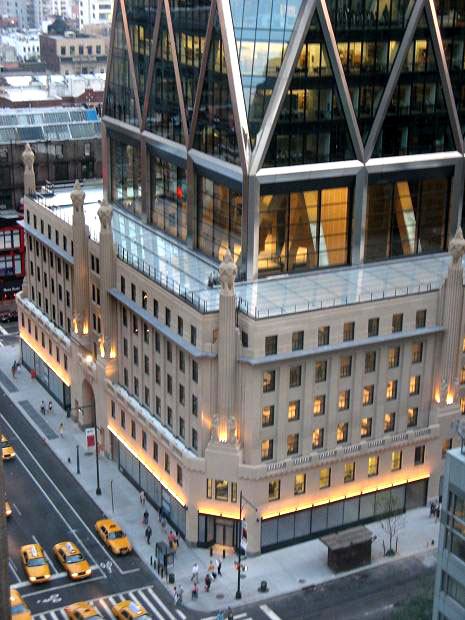
Foster’s design preserves the design of the original Hearst building, which was built in 1928 and landmarked in 1988. The addition emerges as a shaft of four-story high diamond-shaped bands of steel with no vertical columns around the perimeter frame — a design known as a diagrid, which, in addition to giving the form a dramatic and crystalline shape, uses one fifth less steel than a standard design. The views from within the cantered floor-to-ceiling windows offer a unique perspective: tipped down towards the ground, or tilted up towards the sky.
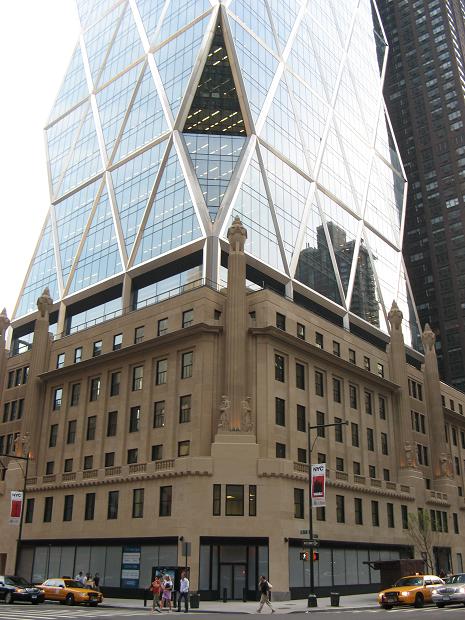
William Randolph Hearst is best known as an American publishing magnate (and one of the inspirations behind Orson Welles’ Citizen Kane.) In 1928, at his empire’s peak, he had 28 major newspapers, 18 magazines, 2 news services, several radio stations and a movie company under his ownership. Hearst was also a fledgling real estate developer, with extensive holdings in New York City and a vision for making his stamp on the city’s landscape. He acquired other properties near the Eighth Avenue and 57th Street site, eventually taking over six lots around Columbus Circle, which he envisioned transforming into his own Hearst Plaza, to supplant Times Square and Herald Square as the city’s publishing hub.
At the heart of the plan was the Art Deco limestone International Magazine Building designed by Joseph Urban, an architect also known for his Hollywood and Broadway set designs. The six-story building at 959 Eighth Avenue was designed to structurally support a larger tower to be added on. When the stock market crashed in 1929, however, Hearst’s prospects declined and plans for the intended tower fell through. The low-rise base is the only remnant of Hearst’s ambitious plan.
The yellow cast stone structure, with its pylons, pedestals and sculpted figures was dismissed by The New Yorker architecture critic as “theatric architecture.” For years, the too grand building seemed out of place in its environs, set upon what was not particularly prime Hells Kitchen commercial real estate: too far west from the elegant heart of 57th Street, and until the late 1990s gentrification, neighboring tenements and adult video shops on a somewhat seamy stretch of Eighth Avenue.
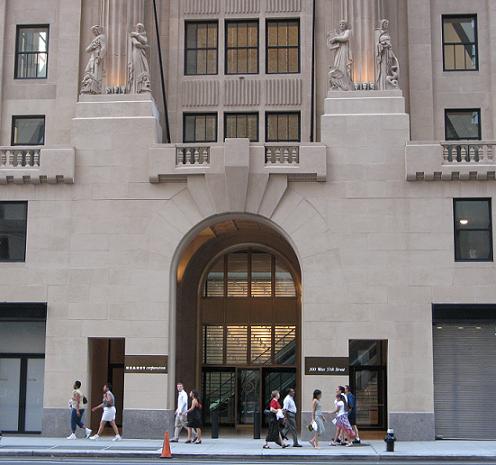
The arched main entrance is flanked by figures representing “Comedy and Tragedy” and “Music and Art.” “Sport and Industry” and “Printing and the Sciences” wrap around the other walls. In his redesign, Foster gutted the original building – interior walls, floors and all – preserving only its outer shell to enclose the glass-roofed “urban plaza.” Through the archway, you can peek a sliver of “Ice Falls,” the three-story, glass sculpted water wall, designed by James Carpenter. In addition to serving as the stunning, sparkling centerpiece of the building’s atrium, the feature serves an environmental function by humidifying and cooling the lobby as necessary. It runs entirely on recycled rainwater collected from the tower’s rooftop — water which is also used to feed into a special pumping system to irrigate plants and trees around the building. Nice!
The view from my Saturday seat:
Banh mi, oh my
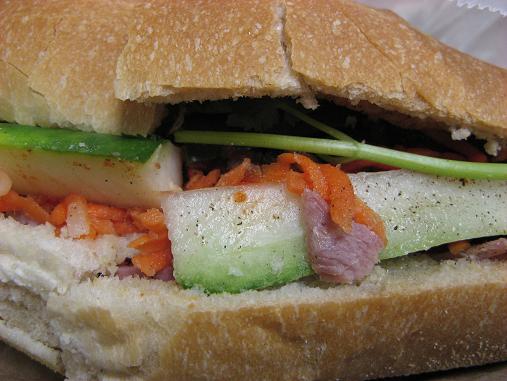
For lunch this afternoon, I decided to stroll up to the Chinatown border for a bánh mì — the Vietnamese sandwich of warm, toasted French baguette, pâté, shredded carrots, daikon, cucumber, cilantro and meats topped with a variety of sauces and seasonings, a culinary marriage of French and colonial-era Vietnamese cultures.
On a nice day, it’s a pleasant stroll past City Hall Park to the closest sandwich shop, on the corner of Lafayette and Walker. Today, however, was not a nice day: it was, in fact, very hot and very humid, and halfway through my decidedly unpleasant 20 minute walk, I was berating myself for not having taken the subway.
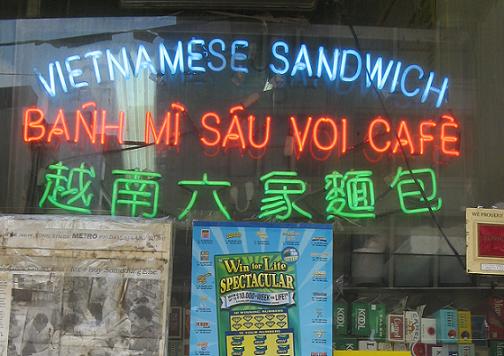
Sáu Voi Corporation is not the name of a place one would associate with cheap and tasty sandwiches. In fact, it’s a tiny, no-frills convenience store, crammed to the brim with a random assortment of brassieres, Vietnamese pop music, cigarettes and lottery tickets. The neon sign advertises the primary reason for most visits to the shop.
The right half of the store is dedicated to the Sáu Voi “Cafe” — really just a counter loaded with prepared Vietnamese snacks, behind which two women work in cramped quarters, brewing coffees and slapping together some dozen or so varieties of bánh mì.
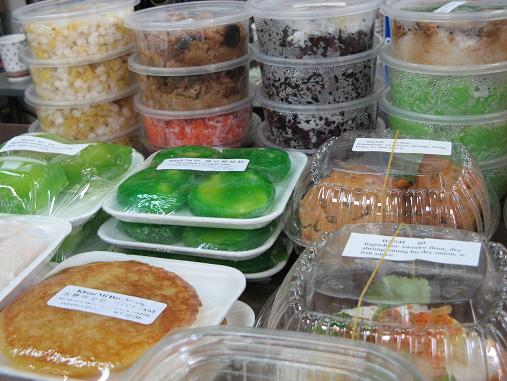
Maximum capacity for the store is about half a dozen people, and during peak lunch hour the line can spill over to the outside. The women working the food counter, though, are models of efficiency: from order to pick-up, I’ve never had to wait more than five minutes.
According to the menu, the Saigon bánh mì I ordered is made with “BBQ minced meat and slices of pork roll or ham.” Not sure what “pork roll or ham” means… is that chef’s choice? Or are they unsure about what to label the mystery meat? Well, whatever it is, it’s tasty — if not quite as tasty as the one I had in Ho Chi Minh City last month — and for $3.00, tax included, I’m not going to think about it too much.
New York City has several bánh mì shops scattered mostly throughout downtown Manhattan and in Brooklyn. The best one is a matter of some foodie debate, but many seem to recommend Saigon Bánh Mì, formerly located in the shadow of the Manhattan Bridge, but recently relocated to Mott at Grand Street. That’s about six blocks farther from my office than my old standby Sáu Voi, so I’ll wait for the weather to turn cooler before I investigate.
After work, I dashed home to pick up the pasta salad I made last night for SYB’s dinner party. As per sketchy usual, M and I had arranged to meet on the subway platform. She’d brought her usual contribution of booze, and we flirted briefly with the idea of ditching the dinner to set out on our own picnic. Cooler minds prevailed, though, and we made it to Sunnyside with our cargo intact.
Full house at SYB’s. We missed out on AC’s Baltimore crabcakes, which made me a little sad, but at least people seemed to enjoy the pasta, enough at least that I was spared having to carry home any leftovers. As the night wore on, the talk turned saucy — could it have been the effects of the Summer savory in my salad? More likely M’s giant pitcher of Sex on the Beach, made with cranberry juice, orange-pineapple juice, and entire bottles of Absolut vodka and Peach schnapps.
More hooking
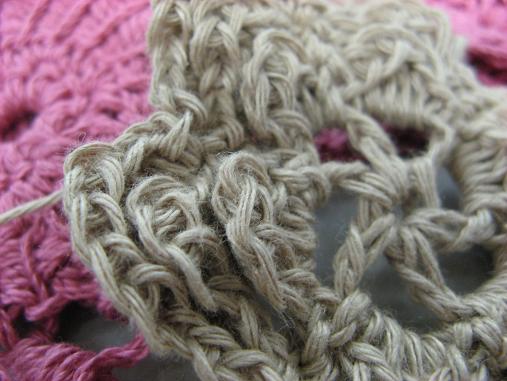
Another good class: today we worked on yarn/color switching, tapestry crochet, making circles, and creating sculptural elements, like flowers. Lisa briefly demonstrated the broomstick crochet technique, so named because the stitches used to be worked around the end of a broomstick; a dowel or fat knitting needle is more manageable and common these days. Class went by so quickly that we didn’t get the chance to work on those stitches independently. Which means more (secret) practice at home for me this week.

Three-fourths through this course I’ve become comfortable enough with my technique to divert attention away to socialize with other students in the class. I got to talking to my seatmate this evening, NDB, a retired psychotherapist turned environmental activist/ inventor/performance artist/elderblogger (her term) and all around inspiring woman. Among her many social causes is increasing awareness about the growing crisis of HIV infection among women over 50.
Statistics show that AIDS cases rose faster in the over-50 population than in people under 40, accounting for 11-15% of new cases in the United States. Older women, among them new divorcees and widows, are particularly vulnerable: after menopause, condom use for birth control becomes unimportant, and physical changes put them at higher risk during unprotected intercourse. Seniors as a group are less aware about STD prevention methods — or consider STDs a concern for younger or gay people; HIV/AIDS educational campaigns generally are not targeted at older individuals.
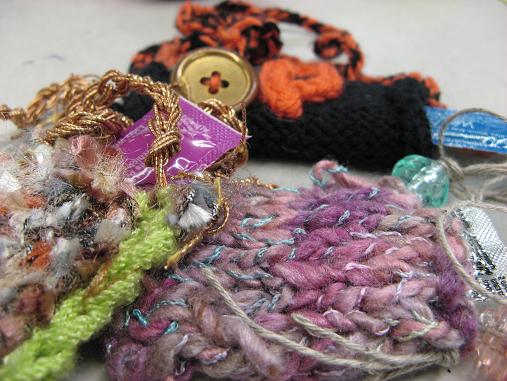
NDB herself has been married for over 40 years, but to promote awareness of this issue, she creates these knitted condom amulets, and encourages others to make (and use!) them:
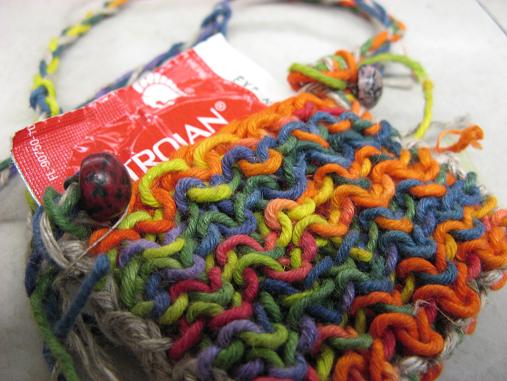
Safety first, everyone, regardless of your age.
I hope that when I’m a septuagenarian, I’ll still be trying to make a difference.
Search
Popular Tags
Categories
Archive
- July 2010
- July 2009
- January 2009
- November 2008
- September 2008
- August 2008
- July 2008
- June 2008
- May 2008
- April 2008
- March 2008
- February 2008
- January 2008
- December 2007
- November 2007
- October 2007
- September 2007
- August 2007
- July 2007
- June 2007
- May 2007
- April 2007
- March 2007
- February 2007
- January 2007
- December 2006
- November 2006
- October 2006
- September 2006
- August 2006
- July 2006
- June 2006