Category: Books
More pencils, more books
My visit uptown coincided with the first day of Spring semester classes at Columbia. Remember how exciting that used to be?
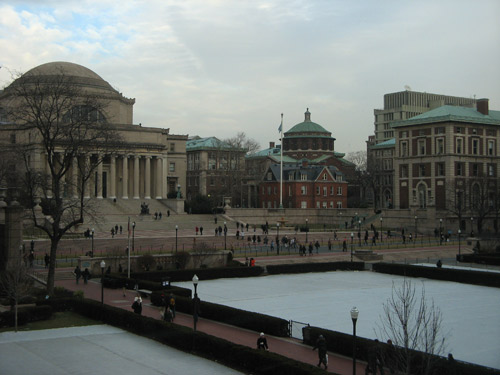
I was last on campus in late October for the talk with New Yorker music critic Alex Ross. Since then, his cultural history of music since 1900, The Rest Is Noise: Listening to the Twentieth Century, has landed on several “Best of 2007” lists including those of The New York Times, New York magazine and Slate. Earlier this month, the book was selected as a finalist for the 2008 National Book Critics Circle Award for Criticism.
Gothamist posted an interview with Ross today, in which he names Radiohead guitarist Jonny Greenwood‘s score to Paul Thomas Anderson’s There Will Be Blood as his current soundtrack to the city. Disappointingly, the 33-minute piece (which has received raves all around) was disqualified from Oscar contention as it recycled parts of Greenwood’s 2005 BBC-commissioned suite “Popcorn Superhet Receiver.”
Ah, we still love you, Jonny.
Von Rezzori reading
At McNally Robinson bookstore in NoLIta for a reading and discussion of Romanian–born writer Gregor von Rezzori‘s recently reissued novel, Memoirs of an Anti-Semite — five connected stories, taking place over several decades, exploring the European aristocrat protagonist’s relationship with and ambivalent attitudes toward Jews.
Von Rezorri’s seminal work was first published in 1969 when he was 65 years old; the English version of the German original was released in the United States in 1981. Before becoming known as a novelist and memoirist, von Rezorri, himself born an Austro-Hungarian aristocrat, was a soldier in the Romanian army and later went on to find stints throughout Europe as a radio broadcaster, writer, filmmaker and artist.
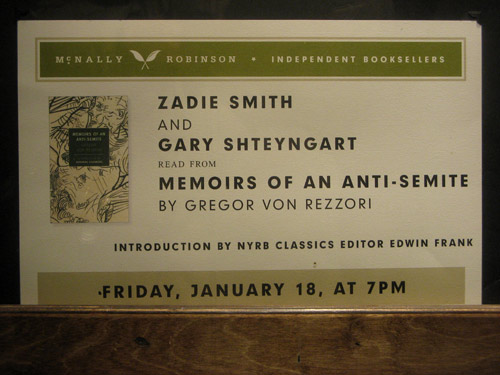
Erica Jong, who had been scheduled to give the introductions tonight, was called away by the birth of her daughter’s twins. The host of the evening was Edwin Frank, editor of the NY Review of Books Classics series, whose mission is to reintroduce great books, like von Rezzori’s, that have fallen out of print or out of sight in recent years.
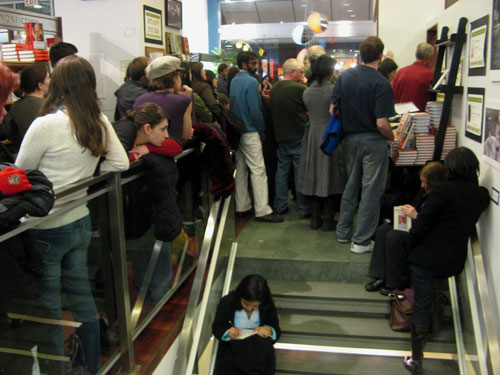
Authors Zadie Smith and Gary Shteyngart read excerpts from the novel and took questions from the packed audience.
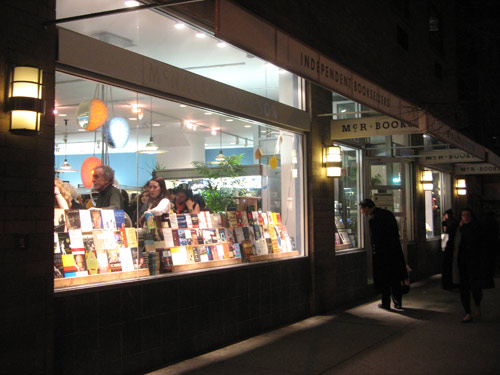
Soviet émigré and Stuy alum Shteyngart’s debut novel, The Russian Debutante’s Handbook, earned him wide praise and numerous awards – including the Stephen Crane Award for First Fiction and the National Jewish Book Award for Fiction. His follow-up 2006 novel, Absurdistan, garnered near-unanimous positive reviews, prompting Walter Kirn to declare on the cover of The New York Times Book Review, “Like a victorious wrestler, this novel is so immodestly vigorous, so burstingly sure of its barbaric excellence, that simply by breathing, sweating and standing upright it exalts itself.”
But it seemed that what drew crowds to the independent bookstore on Prince tonight was Smith. In 2006, the English novelist was listed among the Time 100 – the magazine’s annual wrap-up of the “100 men and women whose power, talent or moral example is transforming our world.” Smith completed her debut novel, White Teeth, during her final year at Cambridge, and was dubbed by The Guardian as “the first publishing sensation of the millennium.” White Teeth went on to win the Whitbread First Novel Award in 2000, among many other honors. Her third novel, On Beauty, was published in September 2005 and was shortlisted for the 2005 Man Booker Prize. The book won the 2006 Orange Prize for Fiction.
I arrived shortly after the author introductions, and this was the closest I could manage to the stage, and green sweater-clad Smith. Well, it’s a reading, not a sighting.
An evening with the Kitchen Sisters
With so many happenings around New York City on any given day, it’s good to have friends who will clue you into ones you would otherwise miss. Courtesy of a tip from JL (again!): “An Evening with the Kitchen Sisters” at NYU’s Kimmel Center for University Life, overlooking Washington Square Park.
Those who tune in regularly to NPR’s Morning Edition are probably already familiar with the duo of Davia Nelson and Nikki Silva. The two women, who first crossed paths while working on similar oral history projects in Santa Cruz, have been producing radio programs together since 1979. They are the renowned creators of the NPR’s series “Lost & Found Sound,” the Sonic Memorial Project, and “Hidden Kitchens”; their fascinating and provocative radio documentaries have earned them two Peabody Awards and a duPont-Columbia Award.
Most of tonight’s program was framed around the Kitchen Sisters’ past radio features, chronicling little told stories of American kitchen and food culture, past and present. The pair had an easy-going rapport with each other and with the audience (several members of whom were called upon to read from their book) — and much livelier than their Saturday Night Live counterparts.
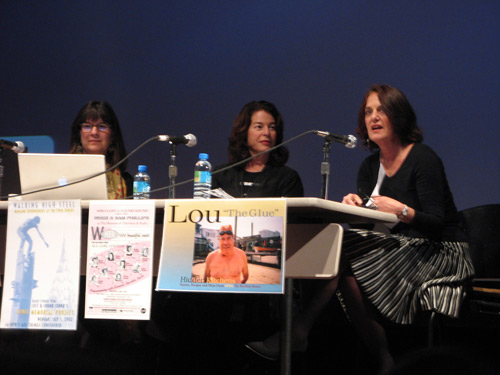
Nelson and Silva shared many fascinating stories about food subcultures: a Kosher cafeteria in New York City’s diamond district, Christmas dinner at a nail salon in San Francisco where dozens of Vietnamese manicurists convene from around the city… the women provided context for the stories while sharing selected clips from their radio series as well as a few listener phone messages that inspired the topics. Among the projects were a few non-food-related stories, such as that of WHER, the first “all girl” radio network that broadcast out of Memphis, Tennessee for 17 years, beginning on October 29, 1955. With hushed awe in their voices they talked about their interviews with members of the Mohawk Indian tribe, working precariously high above the ground to build much of our city’s skyline.
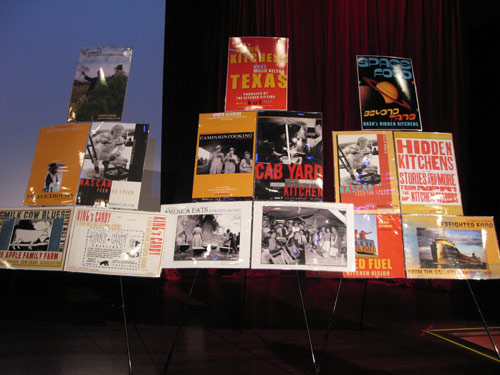
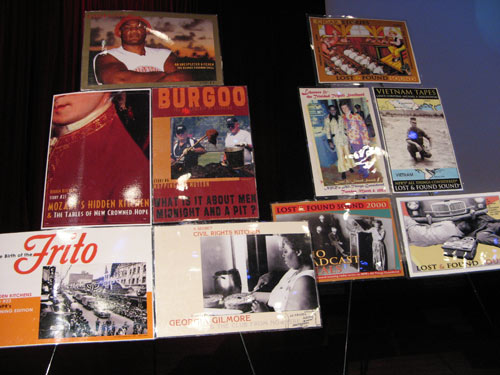
I was struck by the Kitchen Sisters’ obvious passion for their work — how would I go about getting a job like this? — and the women’s affection for their subjects; at one point, over an audio excerpt of their “Milk Cow Blues” story about an Indiana farm community divided over the sale of raw milk, Nelson was moved to visible tears, despite admitting to having heard the clip dozens of times before. The piece offered a nice segue for the women to introduce from the audience food writer Frederick Kaufman who in November, 2004 wrote an article for The New Yorker entitled “Psst! Got Milk?” about his infiltration of a private raw-milk coven in Hell’s Kitchen. (Slightly off-topic, Kaufman — who also happens to be Nelson’s cousin — amused everyone with his musings on food porn conventions.)
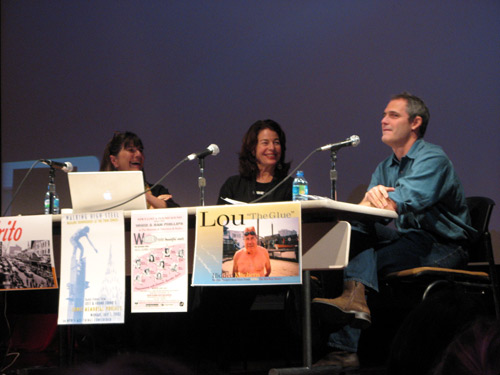
Finally, there was the ultimate “hidden kitchen” story of Robert “King” Wilkerson, who spent 31 years in the Angola State Penitentiary for his involvement with the Black Panthers, 29 of those years in solitary confinement. During that time, Wilkerson developed a recipe for pralines, prepared over a contraband stove in his cell fashioned from cans and tissue paper. As a free man now, he sells his candy with much of the proceeds going towards helping his still-imprisoned cohorts fight for freedom. The Kitchen Sisters brought baskets of King’s “freelines” with them this night, which were distributed throughout the delighted audience for sampling. A sweet ending to a wonderful night of stories.
| S | M | T | W | T | F | S |
|---|---|---|---|---|---|---|
| 1 | 2 | 3 | 4 | 5 | 6 | |
| 7 | 8 | 9 | 10 | 11 | 12 | 13 |
| 14 | 15 | 16 | 17 | 18 | 19 | 20 |
| 21 | 22 | 23 | 24 | 25 | 26 | 27 |
| 28 | 29 | 30 | ||||
Search
Popular Tags
Categories
Archive
- July 2010
- July 2009
- January 2009
- November 2008
- September 2008
- August 2008
- July 2008
- June 2008
- May 2008
- April 2008
- March 2008
- February 2008
- January 2008
- December 2007
- November 2007
- October 2007
- September 2007
- August 2007
- July 2007
- June 2007
- May 2007
- April 2007
- March 2007
- February 2007
- January 2007
- December 2006
- November 2006
- October 2006
- September 2006
- August 2006
- July 2006
- June 2006