Category: Books
Yiddish Policemen and Suburban Girl
I’d scheduled a rather ambitious evening for myself weeks before there were any plans of globe-trotting, and by late this afternoon, I was running on Coke Zero. (Must be the Ace-K that makes it taste so good.)
After work, it was up to the 92nd Street Y, where tonight’s featured reader was another of my favorite authors, Michael Chabon. Chabon, who pronounces his name “Shea as in Stadium, Bon as in Jovi,” is best known as the 2001 Pulitzer Prize winning author of The Amazing Adventures of Kavalier & Clay — one of the ten best books of the past ten years set in New York City. The comic book set knows him better for his award-winning spin-off graphic novel series and as the screenwriter behind Spider-Man 2; film buffs, as the author of the stories on which 2000’s Wonder Boys and the upcoming The Mysteries of Pittsburgh are based.
All groups were represented in the capacity audience tonight – thanks in part to the rather extensive media promotion of the event, based on Chabon’s ongoing weekly serial in The New York Times and the controversy surrounding his new book, The Yiddish Policemen’s Union, dropping on bookstores that day.
Chabon easily defused any lingering tensions by opening the evening: “Is there anyone here tonight who’s already mad at me?” Nervous twitters and surreptitious head-swiveling eased into laughter when after a beat, he continued: “Then I’ll see what I can do.”
The author went on to talk about the early inspiration for his latest work and the role his faith plays in his writing. And after reading a short excerpt of The Yiddish Policemen’s Union, he submitted to an interview with Salon co-founder Laura Miller, followed by “fawning praise and obvious questions” from the audience… during which there were absolutely no outbreaks of violence.
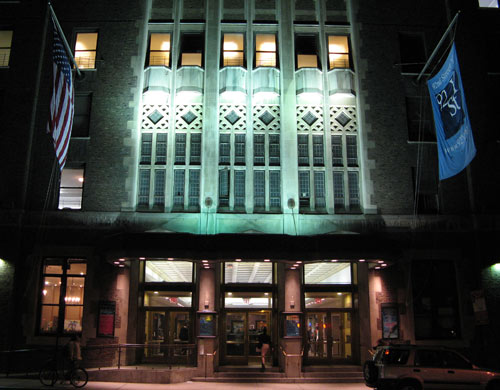
I wish I could have stayed on for the entire evening — or stuck around to get my Kavalier & Clay signed — but I was off into the suddenly wet night to meet M downtown for the Tribeca Film Festival‘s late-night screening of Suburban Girl. The film, starring Sarah Michelle Gellar and Alec Baldwin as the romantic leads (ew ), is based on two stories from Melissa Bank‘s 1999 chick-lit bestseller, The Girls’ Guide to Hunting and Fishing. Marc Klein, best known for his screenplay to 2001’s Serendipity, wrote and directed what was overall a not-so-entertaining, rather confusing mess of a film. Based on the enormous popularity Bank’s debut book, I can only assume that the source material was ill-served.
Sadly, the heartiest audience laughs seemed to have been at the expense of absent Baldwin, whose Mr. Big-esque character was asked to deliver some unfortunately-timed lines about a “vindictive ex-wife” and — worse, still — to leave a phone message for his estranged daughter. (I have to admit, I snickered there, too.)
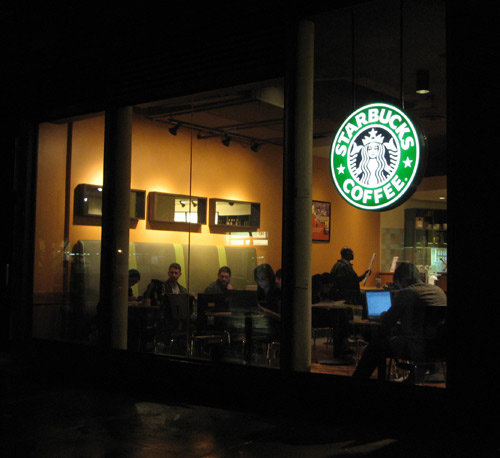
On the way home, the 24-hour Starbucks in my neighborhood. 1 in the morning on a Wednesday and not a free table in sight.
All these words
After powering through the final week of 7 train detours, I stopped by the Strand Bookstore for a quick hello with the Deadline Club boys who were browsing through the shop’s much touted “18 miles of books.” The bookstore, one of the city’s few remaining independent booksellers, opened in 1927, and although my memory doesn’t extend quite that far back, I do recall when the store lay claim to 8, and not 18, miles of books. The number refers presumably not to floor space but to all the new, used, rare and out-of-print books laid end-to-end.
Since opening the 4,000 square foot shop on New York’s once-fertile Book Row five decades ago, the owners have expanded their stock to encompass five floors (of the eleven-story building they now own), and an annex on Fulton Street in the financial district.
Downtown, The Poets House in SoHo was hosting the opening reception of their impressive showcase exhibit featuring all of the poetry published in the United States over the last year. (On view through April 30, 2007.) Several of the writers were in attendance that evening to mingle in the packed house among like-minded literary types (and fellow YoCos.)
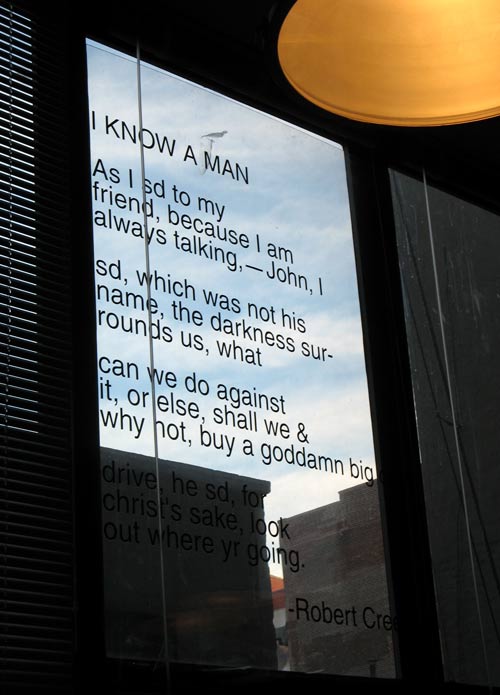
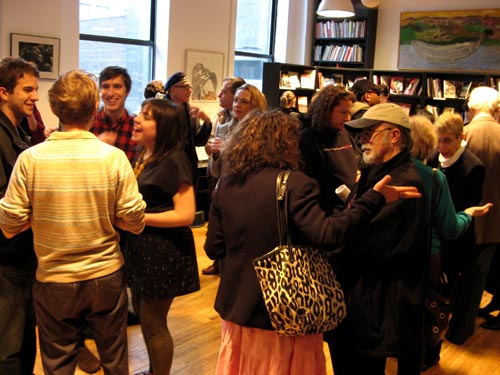
All of which seems to rebut the assertion made in an infamous opinion piece that appeared in Newsweek in May 2003: “Poetry Is Dead, Does Anybody Really Care?” According to the author, Bruce Wexler, “[p]oetry is designed for an era when people valued the written word and had the time and inclination to possess it in its highest form.” The passion of the responses that appeared after that essay was published would indicate otherwise… as would the countless MFA programs and weekly poetry slams that proliferate through the towns across America like Starbucks. (And I mean that in a good way.) Is poetry “the only art form where the number of people creating it is far greater than the number of people appreciating it,” as Wexler asserts? Poetry may be far from dead, but is it relevant in the Internet age of fast-paced media?
I hope so. The Academy of American Poets declared April National Poetry Month in 1996 to encourage more people to acknowledge and appreciate poetry — one of the world’s richest literary traditions.
To end my night: a series of one-act plays at the New School. Bite-sized pieces of drama, none longer than the average sitcom, including one by Obie-award winning, Tony-nominated and 2006 Pulitzer finalist Christopher Durang: an absurdist take-off of A Streetcar Named Desire, with some Cat on a Hot Tin Roof and The Iceman Cometh thrown into the mix.
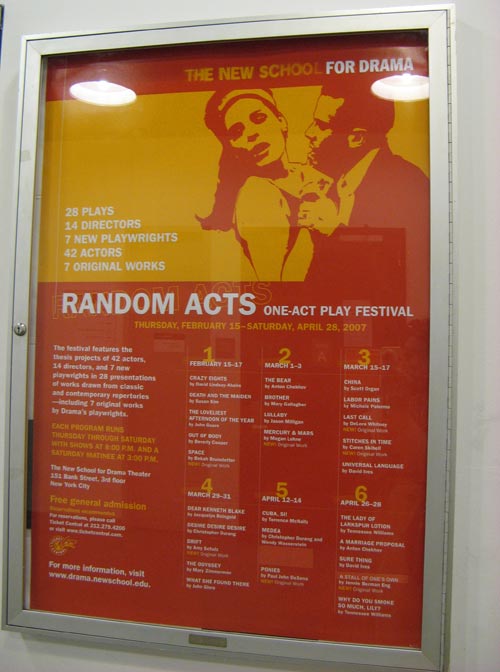
Breathing uneasy
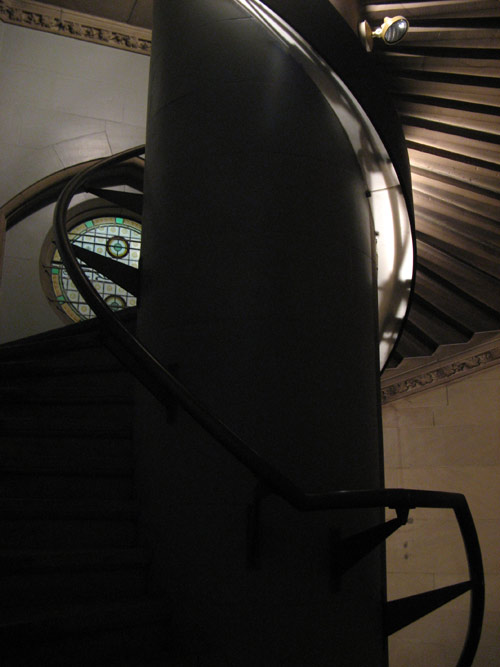
Back at the castle-like Jefferson Market Branch of the New York Public Library for a book club discussion of Noxious New York: The Racial Politics of Urban Health and Environmental Justice.
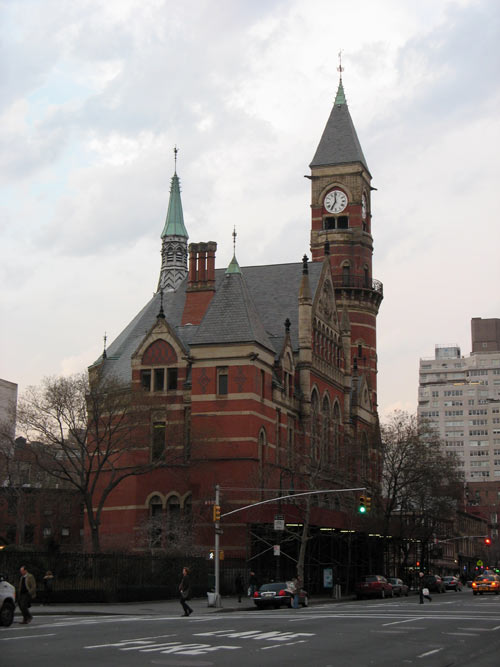
Julie Sze’s book studies how racial minority and low-income communities often disproportionately suffer the adverse effects of urban environmental problems. The Environmental Justice Movement, rooted in both the civil rights and environmental movements, endeavors to bring and sustain environmental quality to these neighborhoods, which often lack the political clout to effect change on their own.
Cecil Corbin-Mark, the first and current Program Director of the West Harlem Environmental Action (WE ACT) led the talk. In addition to his work with WE ACT, Corbin-Mark is an active board member of a number of environmental justice, parks and planning organizations. WE ACT is dedicated to protecting environmental quality, improving environmental health and combatting “environmental racism.” The organization was founded in March 1988 to address ongoing community struggles around the poor management of the North River Sewer (or “Wastewater”) Treatment Plant and the Manhattanville Bus Depot in Harlem.
According to WE ACT, the 7.5 mile area that comprises Harlem is densely populated by half a million residents, yet carries a disproportionate number of the city’s environmental burdens. Above 96th Street (which shares what’s known as an “air corridor” with the South Bronx), there are six of the seven bus depots in Manhattan, the city’s largest sewage treatment plant, and miles of truck-trafficked expressways. Each of these sites is a source of diesel fuel combustion; the toxic emissions are a known health hazard: possibly carcinogenic, according to a 2002 Environmental Protection Agency report, and an asthma irritant.
The diesel particulates have long contributed to increased rates of respiratory illness among neighborhood children, degrading the public health and quality of life in that area. According to Corbin-Mark, Harlem is in the midst of an asthma epidemic; a study conducted in 2003 cited that one in four children in central Harlem has tested positive for asthma — four times the national average of one in sixteen children. The air pollution has also been linked to lower birth weights in Upper Manhattan and South Bronx.
Author Sze, who received her doctorate in American Studies from NYU’s Graduate School of Arts and Science, will talk about her new book at the school on Wednesday evening April 11 in an event co-presented by Transportation Alternatives and UPROSE.
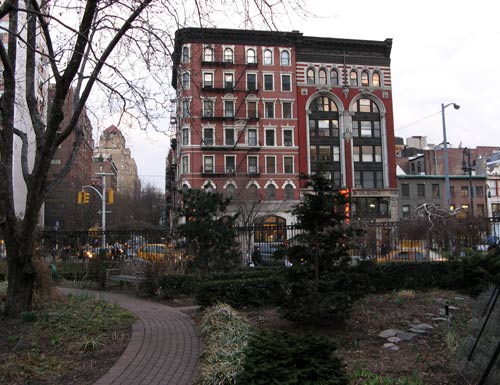
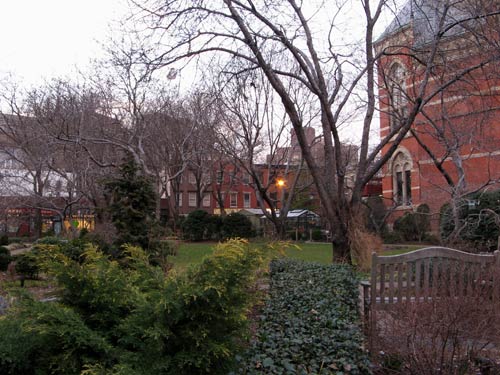
The Jefferson Market Garden, to the south of the library:
| S | M | T | W | T | F | S |
|---|---|---|---|---|---|---|
| 1 | 2 | 3 | 4 | 5 | 6 | |
| 7 | 8 | 9 | 10 | 11 | 12 | 13 |
| 14 | 15 | 16 | 17 | 18 | 19 | 20 |
| 21 | 22 | 23 | 24 | 25 | 26 | 27 |
| 28 | 29 | 30 | ||||
Search
Popular Tags
Categories
Archive
- July 2010
- July 2009
- January 2009
- November 2008
- September 2008
- August 2008
- July 2008
- June 2008
- May 2008
- April 2008
- March 2008
- February 2008
- January 2008
- December 2007
- November 2007
- October 2007
- September 2007
- August 2007
- July 2007
- June 2007
- May 2007
- April 2007
- March 2007
- February 2007
- January 2007
- December 2006
- November 2006
- October 2006
- September 2006
- August 2006
- July 2006
- June 2006