Category: NYC History
War and Peace
JD and MB hosted a brunch at their new apartment in Washington Heights, near Fort Tryon Park. The Hudson View Gardens apartment complex was, at the time it was built in the mid-1920s, the largest housing cooperative in New York and one of the earliest catering to middle class households. Real estate developer Dr. Charles V. Paterno purchased the nearly 4 acres of land, across the street from his (since demolished) castle estate overlooking the Hudson River. His plan was to create a “garden community” of cooperative apartments resembling a medieval English village, to attract those who wanted the comfort and affordability of the suburbs, but still wanted to reside within the confines of New York City.
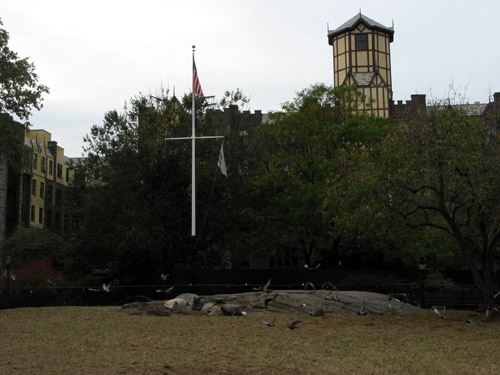
Directly across from the 181st Street subway entrance is Bennett Park, where George Washington set up his base of operations during the Revolutionary War. It was here at Fort Washington that American forces lost the decisive battle of New York on November 16, 1776 to British and Hessian soldiers. The rock outcropping of Manhattan schist in the photo is the highest natural point in Manhattan, 265 feet above sea level.
Brunch was a potluck affair: I brought in the loaf of pumpkin chocolate bread I baked at home the night before; SYB made cheese grits in JD and MB’s new kitchen. The Kiwi couple from Dobbs Ferry brought in mini-pancakes with whipped cream and jam, which I was informed by MB’s cousin R, are called pikelets in New Zealand. (Naturally, I didn’t catch this the first three times he said it, and had to resort to requesting the spelling before I finally understood.)
Over mimosas, we got to listen to the New Zealanders reminisce of home, recounting their tales of drunken blackouts. (“It’s the culture!”) I was both highly amused and slightly disturbed.
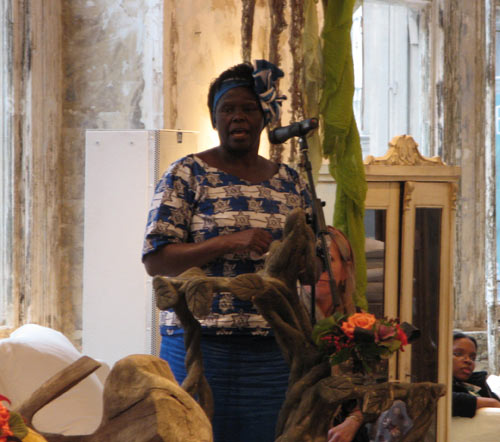
Later, I attended a book launch and reading for The Green Belt Movement founder and 2004 Nobel Peace Prize winner Wangari Muta Maathai. Matthai was promoting her memoir, Unbowed, in which she recounts her remarkable journey from a farm in the highlands of Mount Kenya to becoming the first woman in Eastern and Central Africa to earn a doctoral degree, the first woman in the region to chair a university department, and the first African woman to receive a Nobel prize.

In the mid-1970s, Maathai left academia and founded the Green Belt Movement, Kenya’s most famous environmental and human rights-campaigning group. At its height, the GBM mobilized more than 100,000 women to form tree-nursery groups; the women earned $1 for every fifteen trees they planted, which was, in many cases, their only income. As a result of these efforts, 30 million trees were planted across the country for fuel, building, shade, food, and soil protection on both private land and degraded forests. Women were taught how to plant drought-resistant indigenous crops to feed their families; the transfer of technology from experts to the people turned small-scale farmers into agro-foresters, and raised awareness related to environment and development. The GBM both reduced the effects of deforestation and provided an empowering forum for African women to become creative and effective leaders.
Later still: SYB’s potluck dinner. There was a delicious cassoulet in the Le Creuset, and other tasty dishes from Southern France to supplement. JD and MB (from this morning’s housewarming) brought in crackers and brie. I baked a clafoutis aux cerises to serve with French vanilla ice cream.
Although the love connections were ultimately missed that night, the fine food and wine (and friends) more than compensated for their absence. And CS, AC and AH did discover a new television series, gradually getting sucked in — hour, after NBC marathon hour. Save the cheerleader, save the world.
Design Week @ the Cooper-Hewitt
Met J in Chinatown after work for some quality sister time – high speed edition. After coffee and dumplings, we parted ways, and I headed uptown to meet the B brothers at the Cooper Hewitt National Design Museum. The museum — the only one in the nation devoted exclusively to historic and contemporary design — launched its first ever National Design Week October 15th through the 21st. The event is a new initiative to draw national attention to the ways in which design enriches everyday life. Design Week was organized around the National Design Awards, honoring the best in American design.
The Museum is housed in the stunning former home of steel magnate Andrew Carnegie. Carnegie’s sixty-four-room mansion, built by the architectural firm of Babb, Cook & Willard from 1899 to 1902, pioneered elite uptown development along what became known as Millionaire’s Row. Today, the mansion gives the neighborhood its name: Carnegie Hill. Near the turn of the century, the area on Upper Fifth Avenue was considered the frontier of the city. Carnegie opted for this location to escape the bustle of downtown; the relatively open space also allowed him to build a large private garden — one of the only ones in Manhattan.
The light-filled mansion was built in the solidly comfortable style of a Georgian country house to accommodate personal living quarters (for Andrew Carnegie, his wife Louise Whitfield Carnegie and their daughter, Margaret), servants’ quarters and offices for Carnegie’s philanthropic efforts. It was the first private residence in the United States to have a structural steel frame (used in the skyscrapers) and one of the first in New York to be outfitted with a residential Otis passenger elevator. As with his mills, Carnegie spared no expense for state-of-the-art equipment; his home included sophisticated plumbing and a central heating and cooling system. In the cellar, enormous boilers ran by coal transferred from storage bin to furnace by a coal car that traveled over a miniature railroad track. It is reported that on a typical winter day, it took two tons of coal to heat the house’s five floors.
The mansion and adjacent townhouses were given by the Carnegie family to the Smithsonian Institution, and in 1976, the former residence was re-opened as the Cooper-Hewitt, National Design Museum, Smithsonian Institution. Its bedrooms, libraries, gymnasiums, billiard rooms, and sitting areas were transformed into exhibition galleries, curatorial offices, and conservation laboratories.
The design museum was originally founded in 1897 by Amy, Eleanor, and Sarah Hewitt — granddaughters of industrialist Peter Cooper — as part of The Cooper Union for the Advancement of Science and Art. It became a branch of the Smithsonian Institution in 1967.
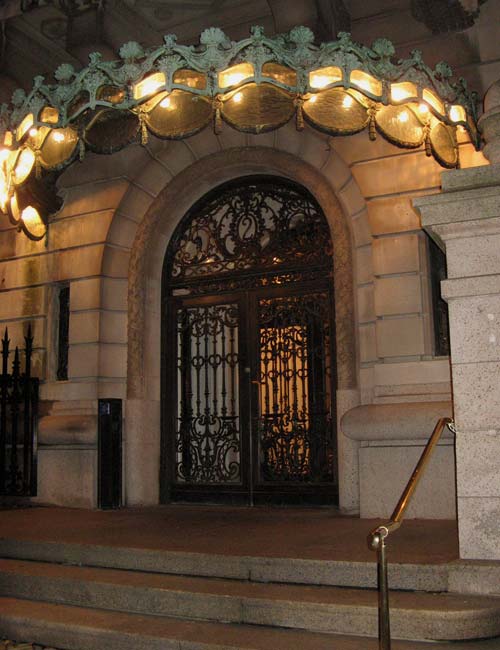
SYB and HYB were waiting under the Louis Comfort Tiffany-style bronze and glass canopy entrance when I arrived.
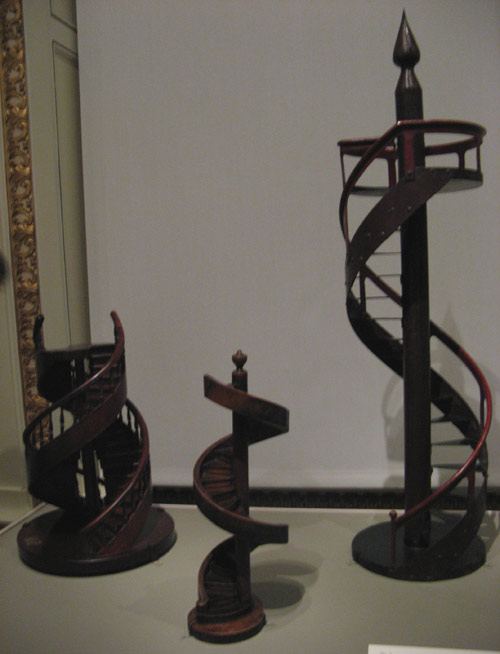
On display: the newly opened Made to Scale: Staircase Masterpieces exhibit — the largest known collection of staircase models outside of France. The majority of the miniatures are from 19th-century France, made by members of a French guild system called compagnonnage, which existed from the Middle Ages and reached its peak from the seventeenth through the nineteenth centuries.
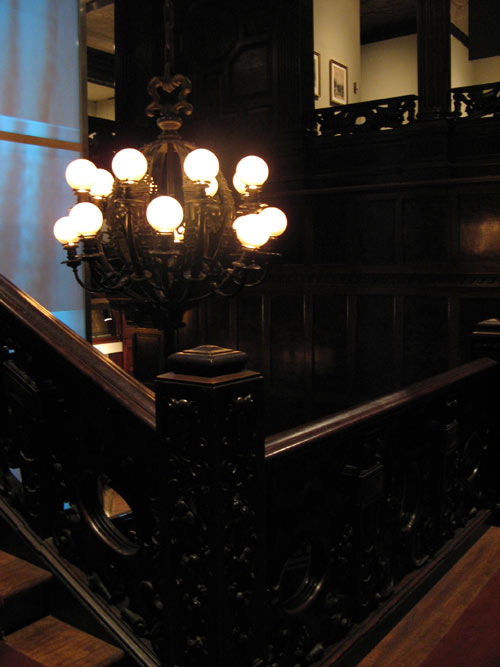
Actual size two-tiered oak staircase of the Carnegie Mansion, which led to the somewhat less interesting upstairs galleries:
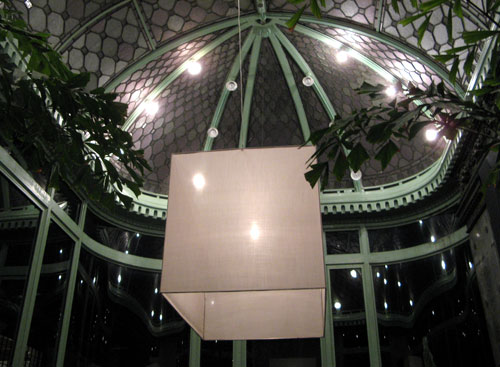
The Barbara Riley Levin Conservatory, which in daytime, features prime views of Carnegie’s private garden. The glass domed room is used sometimes as an exhibition space. It is currently part of Feeding Desire: Design and the Tools of the Table, 1500–2005. This exhibit featured Western dining objects from the Renaissance to the present, and included one very serious-looking silver “ice cream hatchet,” dating to the era when Thomas Jefferson first popularized ice cream in the United States, after his service as minister to France.
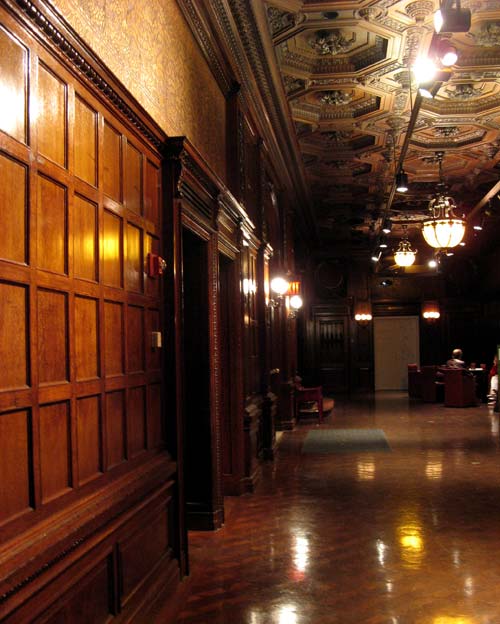
The Great Hall serves as the main entry to the Museum and boasts wonderful architectural detail, including Scottish oak panels and a stone fireplace.
After the museum, SYB, HYB and I met up with SC and JG for a late dinner at Han Bat. The restaurant is located on 35th Street, three blocks away from the neon-lit epicenter of New York’s Koreatown. We let the Korean boys do the ordering this night: Binde Duk (Korean green bean pancakes, mixed with pork), Man Doo Gui (pan-fried Korean dumplings), Bul Go Ki (thin-sliced tender beef), and two of my favorites: Jap Chae (stir-fried glass noodles with vegetables) and Soon Doo Boo Chi Gae (soft tofu stew with hot and spicy sauce and seafood.) Perfect comfort food for this chilly Autumn night.
OHNY 2006 — Part II
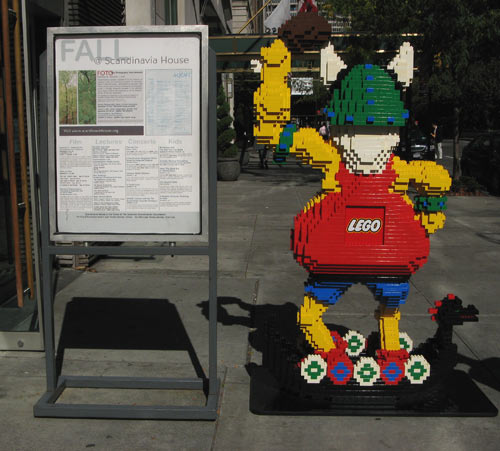
More openhousenewyork weekend fun. In front of the Scandinavia House, headquarters of The American-Scandinavian Foundation, an American non-profit organization that works to build cultural and educational ties between the United States and the five Nordic countries. (Psst… the fifth is Iceland.) Out front: a hilarious LEGO Viking, wielding a drumstick! (Maybe from a street fair.)
No time for the open house tour today, though… or to check out AQ Café, the sleekly modern cafeteria run by Aquavit and its star chef, Marcus Samuelsson. Swedish meatballs and smörgåsbord plates — tack ! (Note: Open Monday through Friday only.)
We arrived just in time for our reservation at the lobby of The Carlton Hotel. Didn’t matter, really, as OHNY wasn’t turning people away, despite the arrival of several more than the printed limit of 25 people for the architect’s tour.
The Carlton on Madison Avenue was restored by renowned architect, David Rockwell of the Rockwell Group. Other historic New York City hotel projects have included the W New York and the W Union Square.) This graceful 1904 Beaux-Arts landmark hotel had grown considerably shabby over the years. During the course of the extensive five-year $60 million dollar renovation and restoration program, workers uncovered this extraordinary 30-foot 1911 Tiffany-style glass dome and original terrazzo mosaic tiled floors — both almost entirely intact, but remarkably hidden under years of soot and grime, accumulated during the space’s prior incarnations.
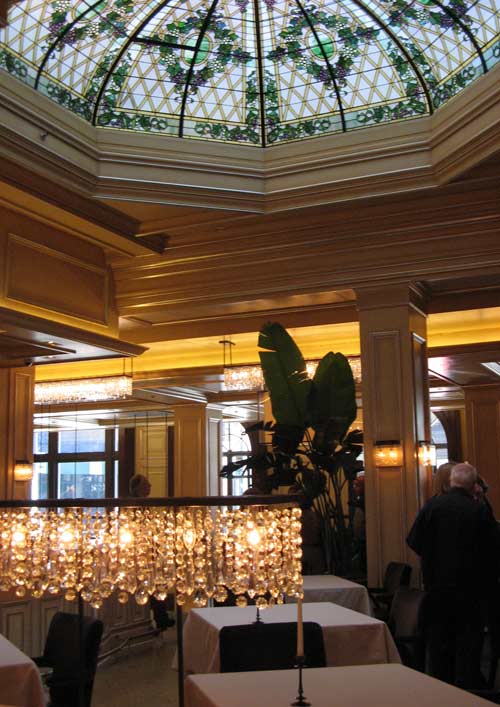
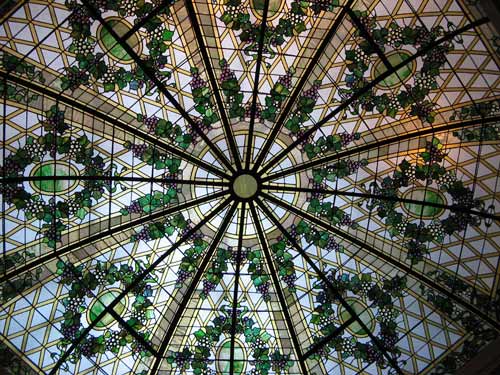
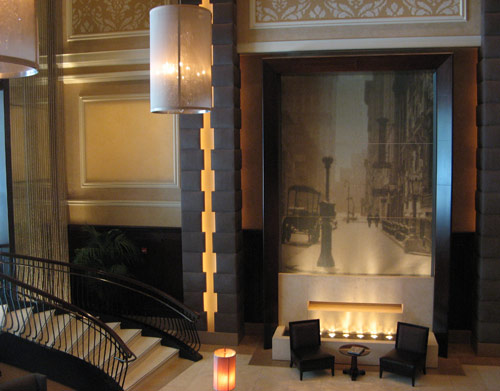
Added during the renovation: large-scale water wall in the three-story lobby. Distinctively modern frosted glass walkways were installed by Rockwell, around the perimeter above.
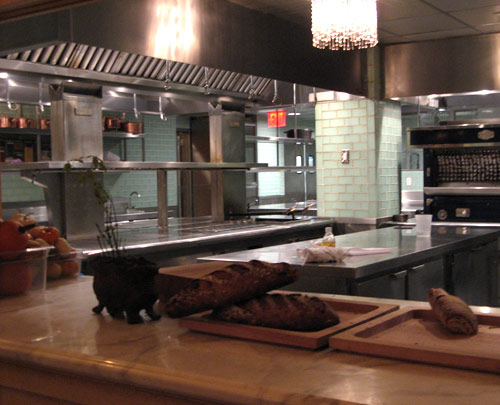
The view from the chef’s table into the open kitchen of Chef Geoffrey Zarkarian upstairs restaurant, Country Restaurant and Café:
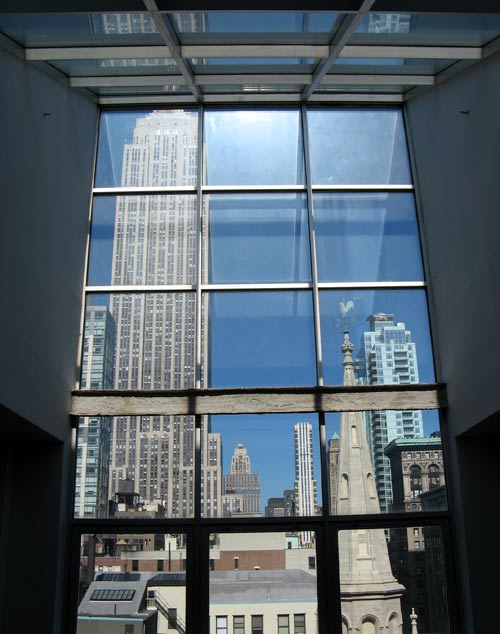
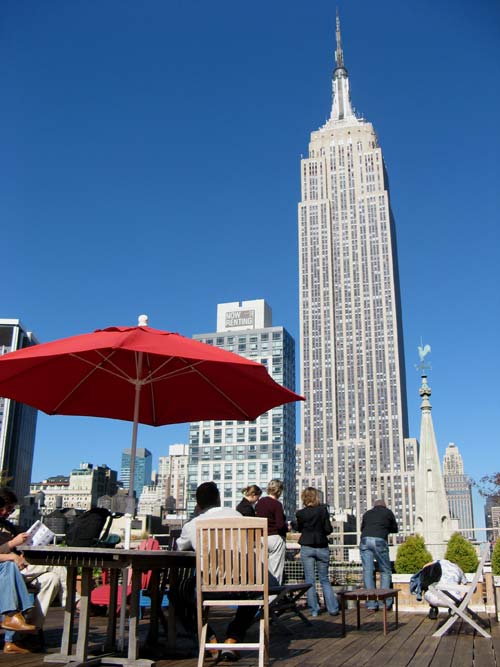
On to OHNY 2006 stop #4: P.S. 260, which, despite its name, is not a public school, but a penthouse film-editing studio. The site was primarily notable for its roof deck and striking views.
Here, the dramatic glass walled entry: that is, of course, the Empire State Building, looming large, on the left.
Up on the roof on this brilliant early Autumn afternoon. This deck was recently used in the filming of both “Spiderman 2” and “13 Going on 30,” for which Sony built a full set with bandstand and dance floor to create the prom scene. (Didn’t see the movie; I read that on the studio site.)
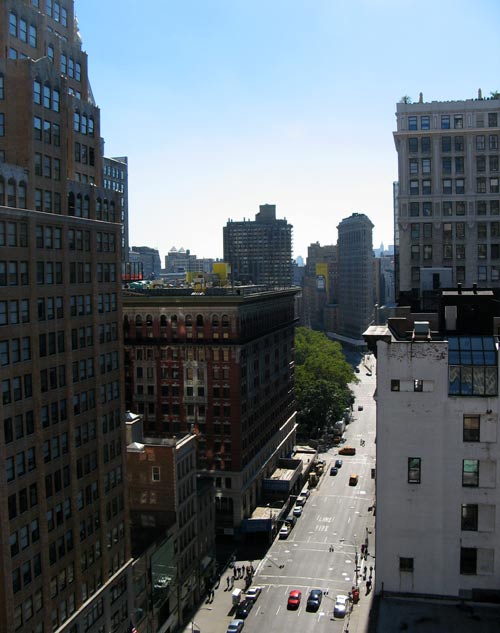
The view down Fifth Avenue to the triangular Fuller Building, better known as the Flatiron Building.
A short walk from P.S. 260, our fifth stop: The Prince George Ballroom, located inside the storied landmarked Prince George Hotel, part of the Madison Square North Historic District.
The 14-story Prince George was built by architect Howard Greenley in 1904 as an exclusive residential and tourist hotel. By the mid-1980’s, it was the country’s largest homeless shelter for families. After decades of decline, the site degenerated into one of New York City’s most squalid, crack-infested welfare hotels. After a 1987 court ruling, the city closed down many welfare hotels, including the Prince George in 1990. The site remained abandoned until 1997, when it was purchased by pioneering housing and community development organization Common Ground Community. The Manhattan nonprofit took over the space to create and manage permanent, affordable housing for low-income and formerly homeless adults.The renovation was spearheaded by Beyer Blinder Belle, the same architectural firm that did the Grand Central Station terminal renovation and The Rubin Museum of Art conversion. The project took over three years and cost $48 million, half of which came from low-interest loans funded by the state and the city. The hotel rooms were reconfigured into 416 studio apartments; over half of the residents are living with a special need, such as mental illness, HIV/AIDS and/or a history of substance abuse. With an average annual operations cost of about $12,000 per apartment, the Prince George is the most cost effective form of supportive housing (e.g., shelters, jails, hospitals, psychiatric wards) in New York City.
In 2004, Common Ground set about restoring some of the building’s former common areas. Working with four other non-profit groups, the organization arranged for at-risk youth, high school students interested in restoration arts, architectural students, and individuals with HIV and AIDS to work on the renovation, offering both job-training and jobs.
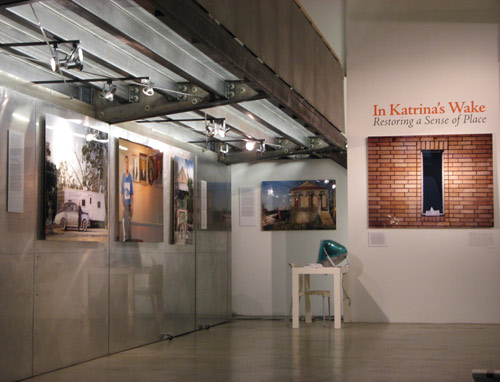
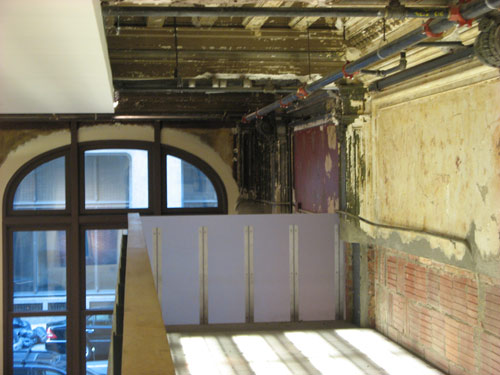
Students from Parsons designed and built the entry foyer and gallery space in what had been the Prince George Hotel’s “Hunt Room.” The result: the modern and airy World Monuments Fund Gallery at the Prince George, currently exhibiting “In Katrina’s Wake: Restoring a Sense of Place. Photographs by Stephen Wilkes.” The Gallery’s sleekly minimalist design highlights the building’s architectural past — and in fact: one upper section was purposely left raw and unfinished, as a reminder of the lobby’s original state.
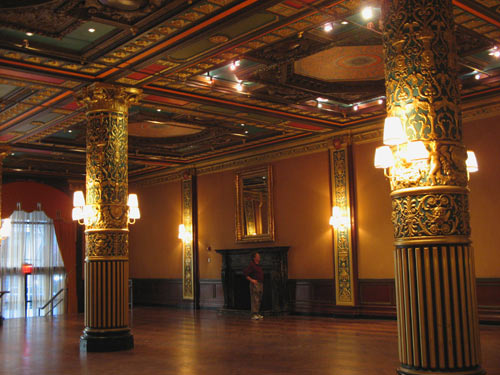
The jewel of the restoration is the 5,000 square foot Prince George Ballroom. Rich with intricate neo-Renaissance gilded plasterwork, elaborately muraled and ornamented 18-foot coffered ceilings, herringbone oak floors, and a striking black marble mantle.
Staff from the Alpha Workshops, which provides training and employment in the decorative arts for people with HIV and AIDS, restored the original water-damaged plasterwork and paint, and provided hands-on training to groups of students from the Brooklyn High School of the Arts, YouthBuild USA and The Christopher, Common Ground’s facility for young adults.
Still more…
| S | M | T | W | T | F | S |
|---|---|---|---|---|---|---|
| 1 | 2 | 3 | 4 | 5 | 6 | |
| 7 | 8 | 9 | 10 | 11 | 12 | 13 |
| 14 | 15 | 16 | 17 | 18 | 19 | 20 |
| 21 | 22 | 23 | 24 | 25 | 26 | 27 |
| 28 | 29 | 30 | ||||
Search
Popular Tags
Categories
Archive
- July 2010
- July 2009
- January 2009
- November 2008
- September 2008
- August 2008
- July 2008
- June 2008
- May 2008
- April 2008
- March 2008
- February 2008
- January 2008
- December 2007
- November 2007
- October 2007
- September 2007
- August 2007
- July 2007
- June 2007
- May 2007
- April 2007
- March 2007
- February 2007
- January 2007
- December 2006
- November 2006
- October 2006
- September 2006
- August 2006
- July 2006
- June 2006