Category: Arts
Shakespeare and Ssäm
SYB and I had reserved tickets to The Public Theatre Shakespeare Lab‘s performance of The Tempest. Tonight’s staging was the culmination of a 13-week intensive acting program. The first two-thirds of the course is class-based, focusing on elements of Shakespearean performance (e.g., monologues, clown work and stage combat); beginning in the 10th week, the students study and rehearse an entire play to perform before a live audience.
A condensed version, anyway: the entire five act play ran 75 minutes with no intermission. Also, to more equitably distribute the lines, three of the parts were shared by two actors: two Mirandas, two Prosperos and two Ariels. The whole thing worked remarkably well, in no small part due to the enthusiasm of the thespians.
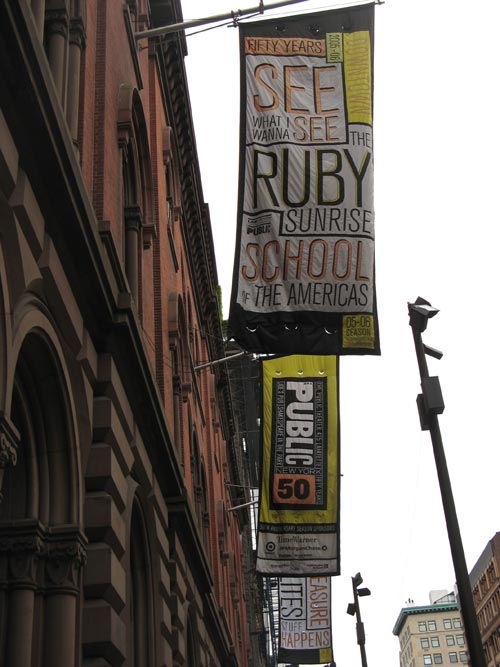
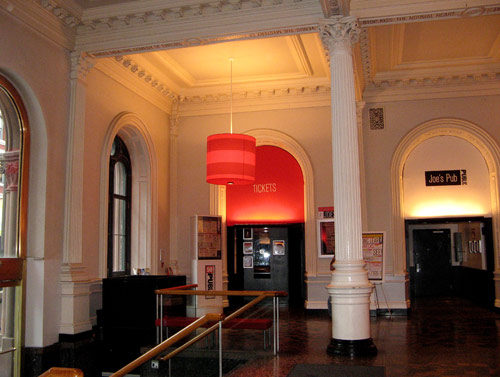
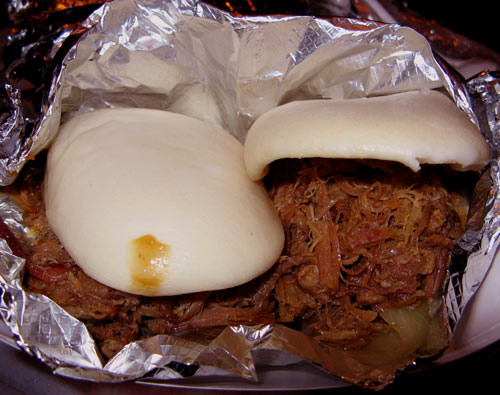
After the performance, inspired by our recent trip to Momofuku Noodle Bar, we thought we would attempt to check out Chef David Chang’s new venture: Momofuku Ssäm Bar. Chang has described the casual dining restaurant’s signature item as an “Asian burrito,” his interpretation of the ssäm, which SYB explained is the Korean word used to describe any wrapped food item. After the hour-plus wait at the Noodle Bar on Saturday night, and the relentless press coverage leading up to the opening earlier this week, we were prepared for the worst.
So we were pleasantly surprised on Thursday night to find the long, sleekly minimalist counter space full, but not packed. After some slight confusion over how to place our orders (turns out you just march up to the glass and relate your choices to the counter guys — cafeteria style), we stood by to watch our ssäms and steamed buns being prepared. The entire experience has been aptly compared to a slicker Chipotles.
As our flour tortillas were being rolled with Berkshire pork and kimchi, who should step out to observe and offer tips than Food and Wine’s Best New Chef 2006 himself. Just for a moment, though — not long enough for me to snap a photo.
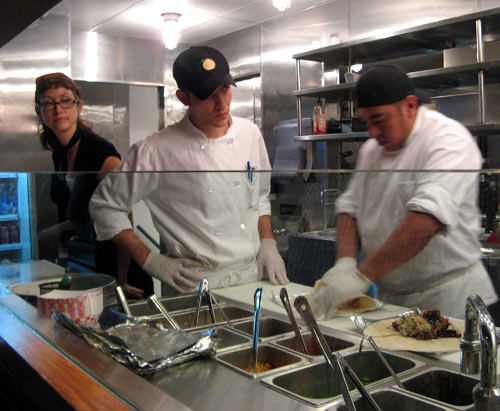
The staff, for their part, seemed slightly amused by all my camera wielding; clearly they’re accustomed to diners of my ilk. At one point, the handsome delivery coordinator asked, “And what blog will these photos be on?”
High style @ MCNY
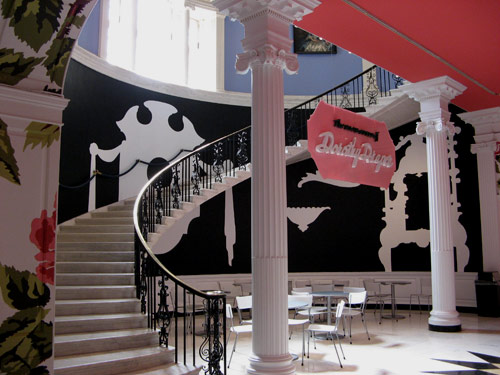
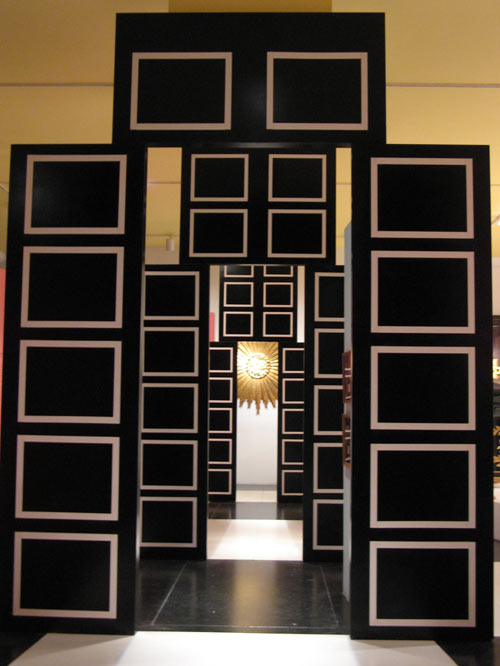
Visited the Museum of the City of New York this morning for “The high Style of Dorothy Draper” exhibit. Once a household name, Draper’s influence as a decorator continues to reverberate as fashion moves away from stark minimalist spaces towards her signature explosions of exhuberant color, oversized accessories, vivid cabbage roses, bright stripes and baroque flourishes. A true style icon and pioneer in interior design, she dominated the field from the mid-1920’s until her retirement in 1960, when she was named America’s most influential tastemaker. The exhibition at MCNY is the first-ever major restrospective of her life and career.
Born Dorothy Tuckerman in 1889 to a prominent and wealthy family – her great-grandfather was a signer of the Declaration of Independence – Draper was raised in the affluent enclave of Tuxedo Park, one of the first gated communities in the United States. (The tuxedo was invented there by Pierre Lorillard in 1886.) Draper was a six-foot tall debutante with an outsize personality to match. After marrying George (Dan) Draper, a doctor from a similarly prominent family, she started up a fledgling decorating business in the 1920’s – essentially creating a new market for packaged style in the heretofore male-dominated construction industry. Her marriage eventually foundered, though, and after three children, her husband asked for a divorce. (Ironically, he married another decorator five years later.) Once freed from the bonds of marriage, the 40-year old Draper’s ambition took off: she renamed her company, and through her society connections (particularly, real estate magnate Douglas Elliman) and distinctive style, was able to score several highly visible commissions: the Carlyle Hotel lobby, a row of Sutton Place tenements (which resulted in the quadrupling of their offer price), and the project which put her on the map: The Hampshire House (now a coop) on Central Park South. She designed the Metropolitan Museum of Art’s cafeteria, the Greenbrier Hotel in West Virginia, the Arrowhead Springs Hotel and Spa in Southern California and the Camellia House Supper Club restaurant at the Drake Hotel in Chicago.
Far from limiting herself to commercial contracts, Draper lent her design sensibilities to projects as varied as the 1952 Packard, a fleet of airplane interiors and the International Hotel at Idlewild (now JFK) Airport. By the 1940’s, her name had developed such cachet that she expanded her empire to make interior design more accessible to the post-War generation of American housewives through the publication of (ghostwritten) books like “Decorating is Fun!“, “Entertaining Is Fun!” and “How to Be a Popular Hostess.” She lent her name to a line of household products, wallpaper, textiles and furniture. She had a nationally-syndicated advice column entitled “Ask Dorothy Draper” — also ghostwritten — that ran in 70 newspapers, 3 times a week.
The company Draper founded is still in existence — over forty years after her death — and her “modern baroque” sensibility has enjoyed a recent renaissance of sorts. Towering achievement for an Edwardian era woman with no formal design or business education.
Afterwards, I stopped for brunch at Itzocan Bistro, a wonderful (and well-reviewed) French-Mex restaurant at 101st and Lexington. The limited brunch menu — a terrific deal at $8.50, including coffee — offered a few intriguing options. I had difficulty deciding between the “Omelet with huitlacoche mushrooms, jalapeno & brie” and the “Baked Eggs with chorizo, poblano peppers & mushrooms.” When in doubt, ask the server; a man who appeared to be the owner (Anselmo?) advised me that while both were good, he personally preferred the baked eggs, though they did entail a bit of a wait. No worries there: I was in no rush to be anywhere else. Overhearing our exchange, a diner at the next table enthusastically seconded the recommendation. He would be in the position to know: I saw remnants of the dish on his plate.
No salsa and chips here: I was tided over with slivers of warm, crusty French bread and butter. Twenty minutes later…
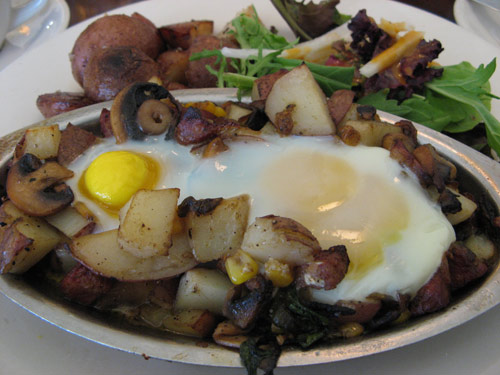
The “baked” eggs were in fact just barely set atop a bed of roasted potatoes with buttery mushrooms and wonderfully spicy chunks of chorizo. C’est si bon! (Or is that: Qué bueno!)
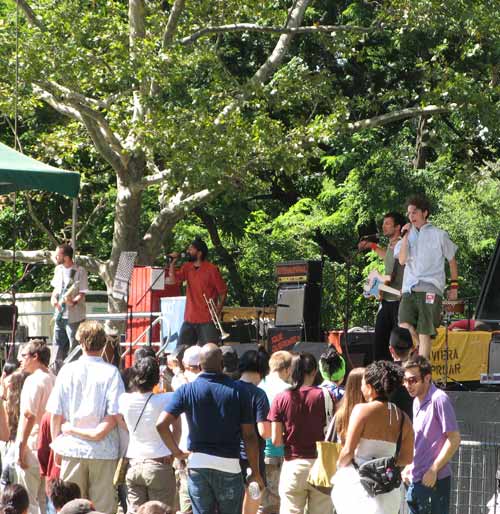
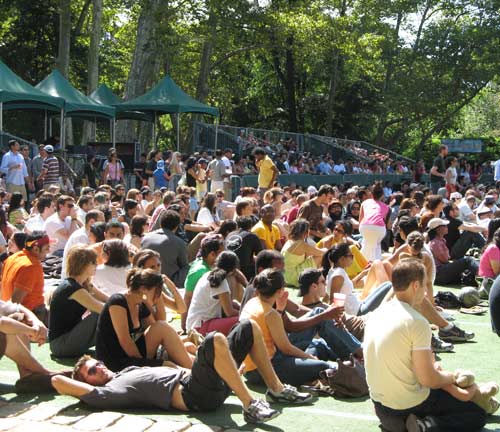
Brooklyn’s Outernational at Summerstage in Central Park:
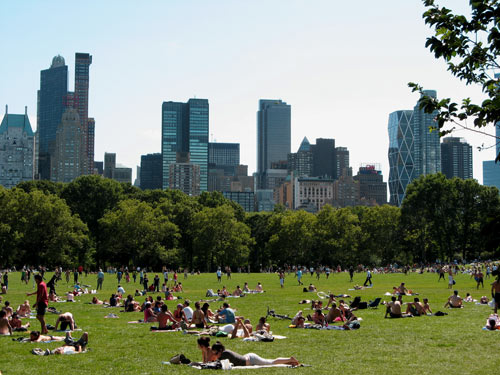
Sheep’s Meadow on a lazy Sunday:
The Morgan Library
The Morgan Library (now the Morgan Library and Museum ) reopened in late April 2006 after a three year renovation and expansion during which the exhibition spaces were doubled by the construction of Renzo Piano’s four-story, steel and glass atrium. We visited during Friday’s late evening hours, after a round of beers (Harp and Magic Hat #9, not Kiuchi Nest) at nearby Ginger Man.
Piano is the Pritzker-prize winning Italian architect, most famous for designing the Centre George Pompidou in Paris. The Morgan Library’s $100M addition is Piano’s first major work in New York City, but there are others planned in the years to come: the new headquarters building for The New York Times Company in Times Square, the Whitney Museum extension and a possible Northern extension of the Columbia University campus.
Renzo’s design links together the original 1906 library, the 1928 Annex, and the 1850s brownstone on Madison and 37th Street. The house was the home of J.P. (Jack) Morgan, Jr. until his death in 1943, after which it served as the headquarters of the Lutheran Church in America. The Morgan Library purchased it in 1988. Prior to the Morgan’s ownership, the house was home to wealthy philanthropists (and married cousins) Helen Phelps and Anson Stokes; their son, Isaac Newton Phelps-Stokes, was born in that house, and grew up to become a historian-author and architect of St. Paul’s Chapel on the Columbia University main campus. In 1966, the chapel was among the first buildings to be designated an official landmark by the New York City Landmarks Preservation Commission.
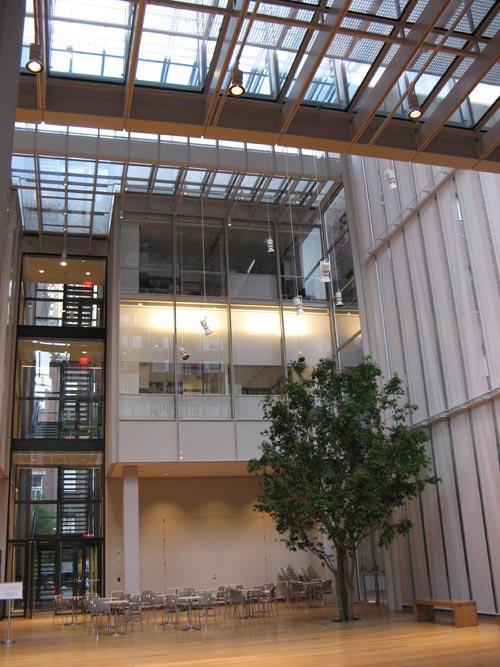
But back to the Morgan. A windowless cube gallery sits off to the South of the airy, new Gilbert Court (below) and serves as a showcase for Morgan’s considerable medieval art treasures, the most important of which is the mid-9th century gold and jeweled Lindau Gospel Book. The room also holds the mid-12th century copper gilt and enamel Stavelot Triptych.
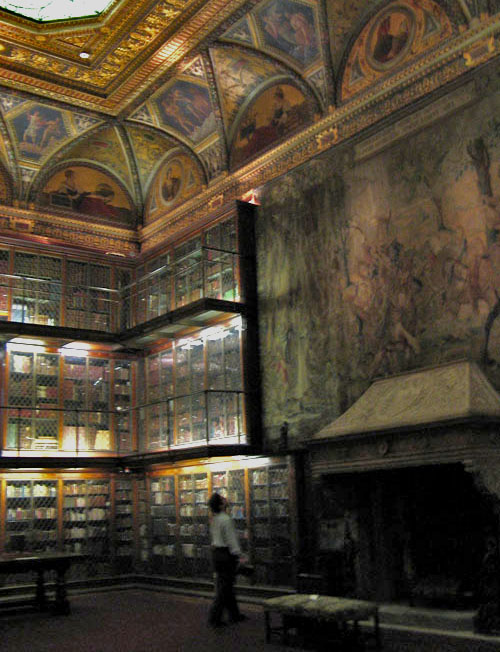
It had been several years since I last set foot inside to view the objets d’art culled together by the senior John Pierpont Morgan, and I was impressed all over again with the breadth of his collection. A large portion was donated to The Metropolitan Museum of Art, of which Morgan was one-time president, but a select few remain here. The original Italian Renaissance-style Library building was built next to Morgan’s brownstone residence (since demolished) as a three-room showcase for his treasures at a personal cost of $1.2M. The East room, actually known as “Mr. Morgan’s Library,” is a majestic yet intimate space with a leaded skylight and vaulted ceiling murals by commissioned artist Henry Siddons Mowbray, head of the American Academy in Rome. The three tiers of dramatic floor-to-ceiling encased shelves are filled with some 5000 leather-bound volumes dating from the 16th to the 20th centuries.
No photos allowed: this one somehow made it into my camera while B stood in between me and the guard’s line of vision.
One highlight of the Library are the Gutenberg Bibles — one was on display in this room. The Morgan collection includes three of the ten copies in the United States — one vellum, and two paper, more copies than even the Vatican (which owns just two). Only sixty or so copies are known to still be in existence worldwide. The only other copy in New York City is owned by The New York Public Library. Yale, Harvard and Princeton Universities each own one copy, as does Bill Gates.
Below, the Rotunda, which sits between Mr. Morgan’s Library and Mr. Morgan’s Study — which with its red damask silk-covered walls and imported 16th century carved wood ceilings was once called the “most beautiful room in America.”
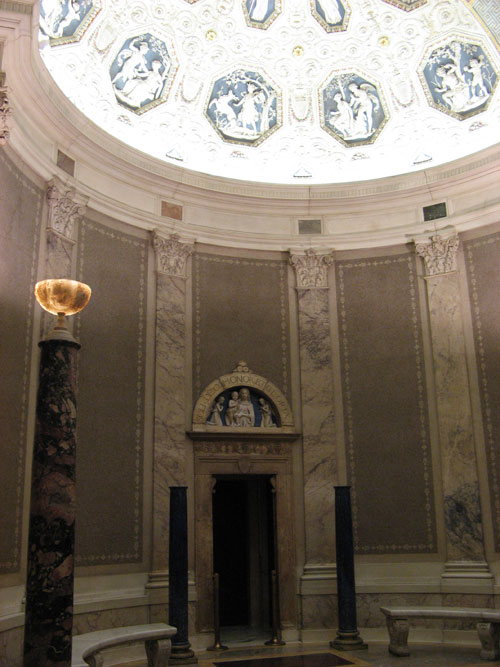
So much to see: drawings by da Vinci, Raphael, Michelangelo, Rubens, Dürer, Rembrandt, Degas and Picasso. Upstairs, an astonishing collection of literary and musical manuscripts: the only existing transcription of Milton’s Paradise Lost, Thoreau’s 40-volume journal, personal correspondence by Benjamin Franklin, crazily cramped early writings by all four Brontë siblings, Austen’s first unpublished novel, and works by Steinbeck, Balzac, Dickens, Poe, Burns, Byron, Keats, Shelley… sheets of music by Bach, Beethoven, Mozart, Chopin, Brahms, Schubert, Schumann, Mahler, Wagner…
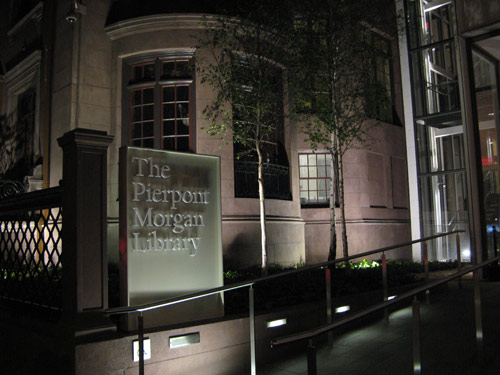
It’s almost too much to take in during one visit. I, for one, am thrilled to have my — okay, our — Pierpont Morgan Library (and Museum) back.
| S | M | T | W | T | F | S |
|---|---|---|---|---|---|---|
| 1 | 2 | 3 | 4 | 5 | 6 | |
| 7 | 8 | 9 | 10 | 11 | 12 | 13 |
| 14 | 15 | 16 | 17 | 18 | 19 | 20 |
| 21 | 22 | 23 | 24 | 25 | 26 | 27 |
| 28 | 29 | 30 | ||||
Search
Popular Tags
Categories
Archive
- July 2010
- July 2009
- January 2009
- November 2008
- September 2008
- August 2008
- July 2008
- June 2008
- May 2008
- April 2008
- March 2008
- February 2008
- January 2008
- December 2007
- November 2007
- October 2007
- September 2007
- August 2007
- July 2007
- June 2007
- May 2007
- April 2007
- March 2007
- February 2007
- January 2007
- December 2006
- November 2006
- October 2006
- September 2006
- August 2006
- July 2006
- June 2006