Category: Arts
Design Week @ the Cooper-Hewitt
Met J in Chinatown after work for some quality sister time – high speed edition. After coffee and dumplings, we parted ways, and I headed uptown to meet the B brothers at the Cooper Hewitt National Design Museum. The museum — the only one in the nation devoted exclusively to historic and contemporary design — launched its first ever National Design Week October 15th through the 21st. The event is a new initiative to draw national attention to the ways in which design enriches everyday life. Design Week was organized around the National Design Awards, honoring the best in American design.
The Museum is housed in the stunning former home of steel magnate Andrew Carnegie. Carnegie’s sixty-four-room mansion, built by the architectural firm of Babb, Cook & Willard from 1899 to 1902, pioneered elite uptown development along what became known as Millionaire’s Row. Today, the mansion gives the neighborhood its name: Carnegie Hill. Near the turn of the century, the area on Upper Fifth Avenue was considered the frontier of the city. Carnegie opted for this location to escape the bustle of downtown; the relatively open space also allowed him to build a large private garden — one of the only ones in Manhattan.
The light-filled mansion was built in the solidly comfortable style of a Georgian country house to accommodate personal living quarters (for Andrew Carnegie, his wife Louise Whitfield Carnegie and their daughter, Margaret), servants’ quarters and offices for Carnegie’s philanthropic efforts. It was the first private residence in the United States to have a structural steel frame (used in the skyscrapers) and one of the first in New York to be outfitted with a residential Otis passenger elevator. As with his mills, Carnegie spared no expense for state-of-the-art equipment; his home included sophisticated plumbing and a central heating and cooling system. In the cellar, enormous boilers ran by coal transferred from storage bin to furnace by a coal car that traveled over a miniature railroad track. It is reported that on a typical winter day, it took two tons of coal to heat the house’s five floors.
The mansion and adjacent townhouses were given by the Carnegie family to the Smithsonian Institution, and in 1976, the former residence was re-opened as the Cooper-Hewitt, National Design Museum, Smithsonian Institution. Its bedrooms, libraries, gymnasiums, billiard rooms, and sitting areas were transformed into exhibition galleries, curatorial offices, and conservation laboratories.
The design museum was originally founded in 1897 by Amy, Eleanor, and Sarah Hewitt — granddaughters of industrialist Peter Cooper — as part of The Cooper Union for the Advancement of Science and Art. It became a branch of the Smithsonian Institution in 1967.
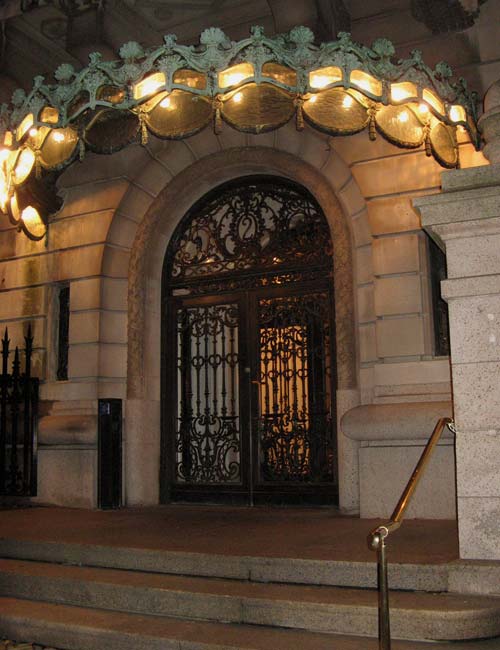
SYB and HYB were waiting under the Louis Comfort Tiffany-style bronze and glass canopy entrance when I arrived.
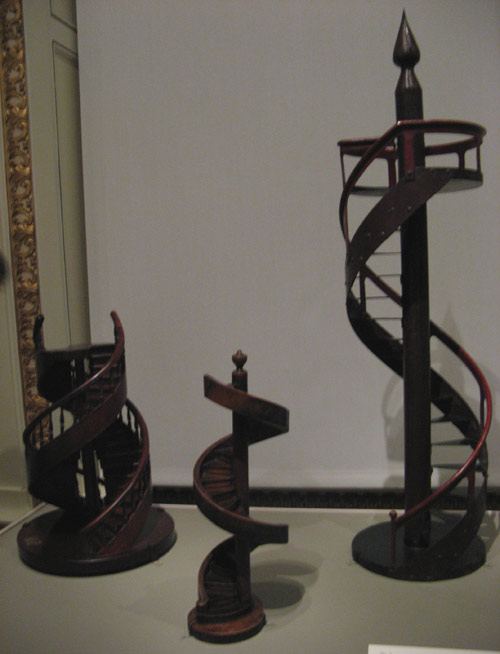
On display: the newly opened Made to Scale: Staircase Masterpieces exhibit — the largest known collection of staircase models outside of France. The majority of the miniatures are from 19th-century France, made by members of a French guild system called compagnonnage, which existed from the Middle Ages and reached its peak from the seventeenth through the nineteenth centuries.
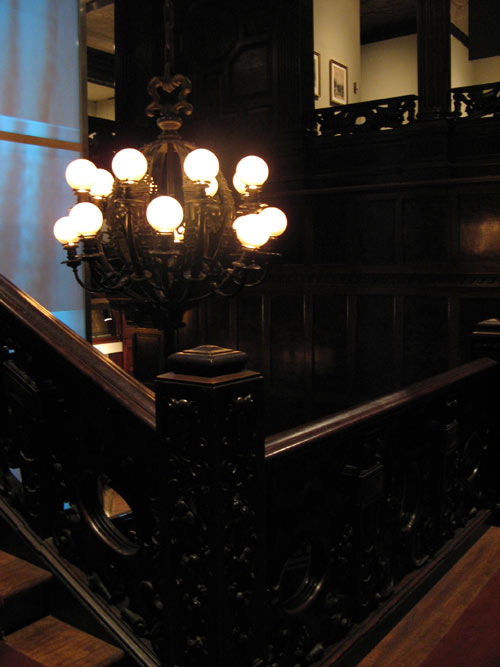
Actual size two-tiered oak staircase of the Carnegie Mansion, which led to the somewhat less interesting upstairs galleries:
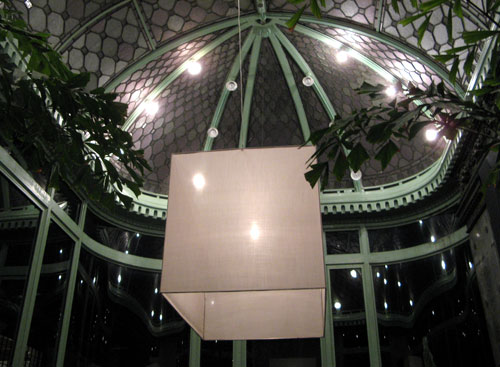
The Barbara Riley Levin Conservatory, which in daytime, features prime views of Carnegie’s private garden. The glass domed room is used sometimes as an exhibition space. It is currently part of Feeding Desire: Design and the Tools of the Table, 1500–2005. This exhibit featured Western dining objects from the Renaissance to the present, and included one very serious-looking silver “ice cream hatchet,” dating to the era when Thomas Jefferson first popularized ice cream in the United States, after his service as minister to France.
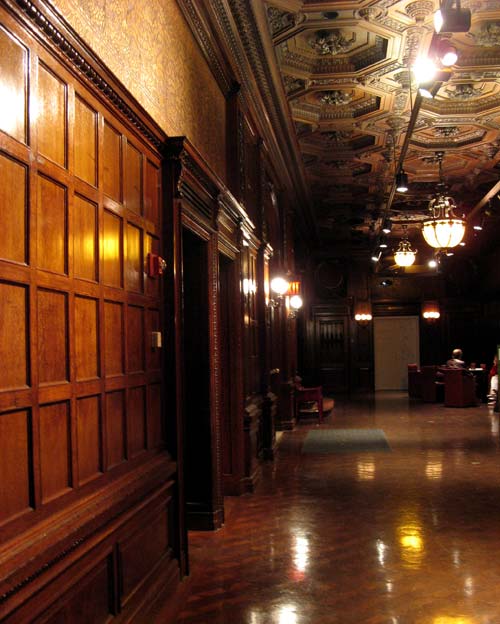
The Great Hall serves as the main entry to the Museum and boasts wonderful architectural detail, including Scottish oak panels and a stone fireplace.
After the museum, SYB, HYB and I met up with SC and JG for a late dinner at Han Bat. The restaurant is located on 35th Street, three blocks away from the neon-lit epicenter of New York’s Koreatown. We let the Korean boys do the ordering this night: Binde Duk (Korean green bean pancakes, mixed with pork), Man Doo Gui (pan-fried Korean dumplings), Bul Go Ki (thin-sliced tender beef), and two of my favorites: Jap Chae (stir-fried glass noodles with vegetables) and Soon Doo Boo Chi Gae (soft tofu stew with hot and spicy sauce and seafood.) Perfect comfort food for this chilly Autumn night.
The Two and Only
I had a pair of tickets to see Jay Johnson‘s one-man, several-puppet show and invited along B, with whom I’d felt a bit out of touch these couple of weeks. It gave us a chance to reconnect, which was nice. He arrived at my apartment early, bearing gifts from his recent business trip to Austin: souvenirs from my favorite Texas barbecue joint, The Salt Lick. Sweet!
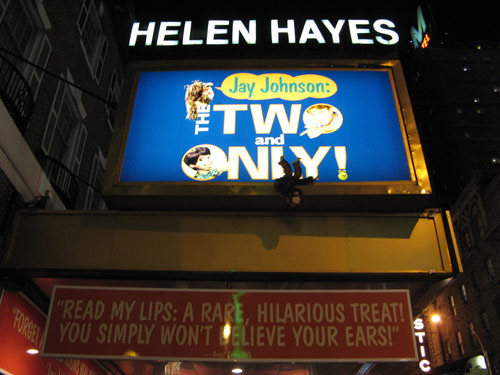
The Two and Only was advertised as a showcase for the ventriloquist, best known for his supporting role on the controversial 1970s sitcom Soap. I don’t generally have a lot of interest in ventriloquists — the whole artform seems a bit antiquated in this era of CGI special effects, and I’ll admit it: the dummies — sorry: “wooden Americans,” as Johnson offers — creep me out a little. But Jay Johnson was a true master of his craft. Over the course of the 90-minute intermission-less show, he played straight-man to a host of vivid characters that emerged from baskets and trunks — and in the most imaginative bit: a dry erase board — strewn about the Helen Hayes Theatre stage: a severed head, Amigo the snake (pictured below — poorly, but it was the best I could manage), Nethernore the vulture, Spaulding the tennis ball, Darwin the manic monkey, his first professional partner, Squeaky and his former Soap co-star, Bob.
A hilarious sequence revolved around the fact that “Bob” was named by a writer who “obviously knew nothing about ventriloquism”. Well, not quite so obviously to an audience of similarly ignorant non-ventriloquists. But as Johnson explained: “B” is an implosive consonant, which forces one’s lips to move to pronounce it – the downfall of any ventriloquist. During one rapid-fire exchange between Johnson and Bob, enormous pains were taken to steer Bob from the letter “B.” (Johnson pulled it off eventually, though, and brilliantly. “Bastards!“)
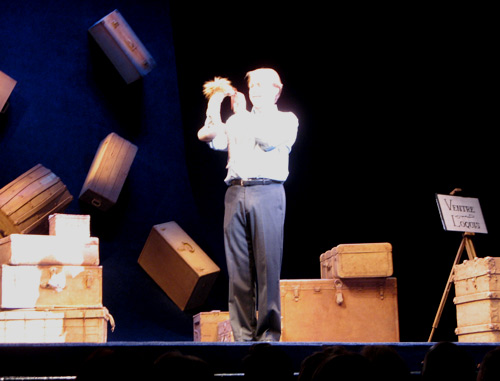
Johnson delivered a brief history of ventriloquism and an explanation of the mechanics of “voice-throwing,” interwoven with an autobiographical account of his humble beginnings in show business as a kid working the lodge circuit in Abernathy, Texas. Aside from being enormously talented, Johnson came off as a genuinely friendly, sentimental guy. The most moving parts of the evening recounted his acquaintance and long distance mentorship under a retired vaudevillian named Arthur Sieving, who carved Johnson his first dummy.
Johnson appears to be one of that rare breed who manages to carve a successful career out of a childhood dream — and there’s quite an inspiration in that.
MOVE FOR AIDS at Public
On Tuesday night, M and I attended Public and AvroKO’s preview showcase of acclaimed Australian photographer (and yoga enthusiast) James Houston’s latest artistic endeavor: MOVE FOR AIDS — for which Houston brought together over fifty of America’s leading dancers in a photography essay created to raise awareness and funds for AIDS charities.
The project incorporates the MOVE FOR AIDS book, published by DUMBO-based powerHouse Books (it’s Houston’s fourth, and the result of a collaboration with design house Hugo Boss), photographic exhibitions, a special documentary on the shooting of MOVE, and dance performances by some of the world’s leading dance companies to launch the project around the world. Houston will be donating all author royalties from book sales of MOVE FOR AIDS to DRA (Dancers Responding to AIDS).
Houston’s background as a sculptor is evident in his shaping of the dancers’ sinewy forms — some of which may not be SFW. The full exhibition will be on view at Manhattan’s MILK Gallery from October 24 to October 29, 2006. After the New York launch, MOVE FOR AIDS will continue on to London to benefit the Elton John AIDS Foundation, and then to Australia to coincide with World AIDS Awareness Week. The exhibition preview was held in the brightly lit jewelbox gallery adjacent to the restaurant, and this night the overflow of attendees lined up along the restaurant’s entrance staircase and spilled out to the sidewalk in front.
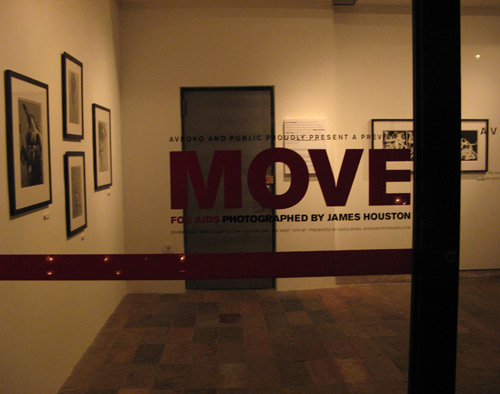
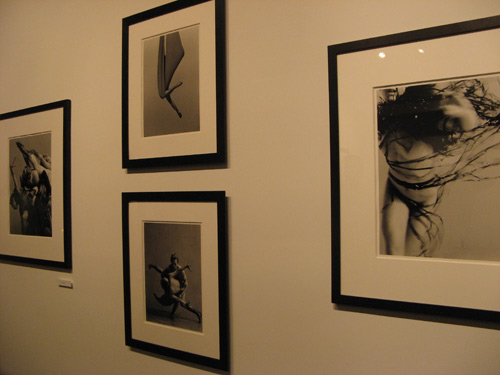
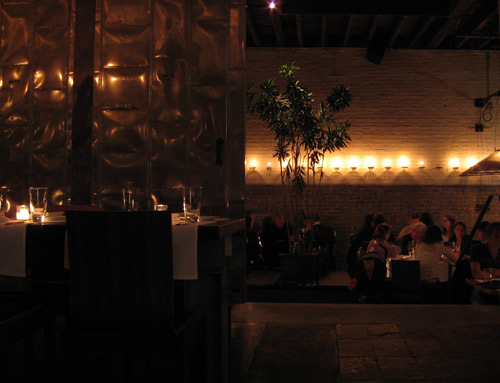
M and I snaked our way in through the room and after touring the small selection of photographs on display (which took all of ten minutes), we took our glasses of Shiraz inside the dining room for dinner. The terrace facing Elizabeth Street, where we were seated last time, was closed off on this brisk night.
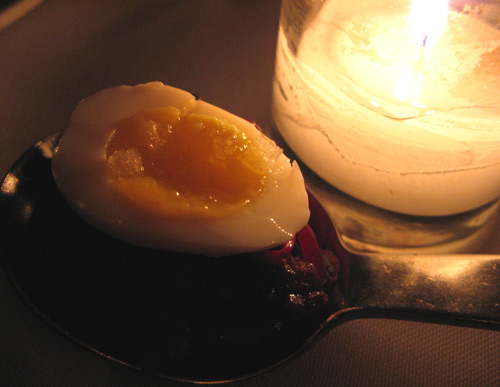
Amuse-bouche, which has been described as “little bites of food to amuse the mouth, invigorate the palate, and whet the appetite.” Indeed! Soft-cooked quail egg, atop an eel cabbage slaw.
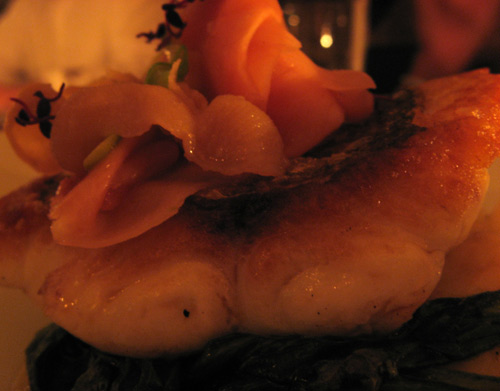
New Zealand snapper on wasabi-boniato mash with poached conch, pickled ginger, and yao choy:
Our meal was accompanied by a fine pinot noir, and finished off with Public’s ultra-rich, ultra-dense chocolate fudge cake, served with a stick of salty, sweet peanut brittle and a scoop of Guinness ice cream. M is still waiting for her favorite “Hokey pokey ice cream with a ginger snap” to make its return to the dinner menu. (Currently only available for brunch.)
Comforting to know that even after she defected to the other side of the river, my (lesbian) friend can still make time for us New Yorkers… even as she tries to recruit a select few over to the Garden State.
| S | M | T | W | T | F | S |
|---|---|---|---|---|---|---|
| 1 | 2 | 3 | 4 | 5 | 6 | |
| 7 | 8 | 9 | 10 | 11 | 12 | 13 |
| 14 | 15 | 16 | 17 | 18 | 19 | 20 |
| 21 | 22 | 23 | 24 | 25 | 26 | 27 |
| 28 | 29 | 30 | ||||
Search
Popular Tags
Categories
Archive
- July 2010
- July 2009
- January 2009
- November 2008
- September 2008
- August 2008
- July 2008
- June 2008
- May 2008
- April 2008
- March 2008
- February 2008
- January 2008
- December 2007
- November 2007
- October 2007
- September 2007
- August 2007
- July 2007
- June 2007
- May 2007
- April 2007
- March 2007
- February 2007
- January 2007
- December 2006
- November 2006
- October 2006
- September 2006
- August 2006
- July 2006
- June 2006